There’s a question most people skip when they’re building their online presence:
“Can anyone actually find me?”
Not just Google. Not just your ideal reader typing keywords into a search bar. But also the AI assistants ChatGPT, Perplexity, Claude, Gemini that millions of people now use to get recommendations, research tools, and find creators to follow.
Welcome to the era where SEO (Search Engine Optimization) has a new sibling: GEO Generative Engine Optimization.
And if you’re a writer, solopreneur, SaaS builder, or small business running lean? This audit is built for you.
Let’s tear it all down.
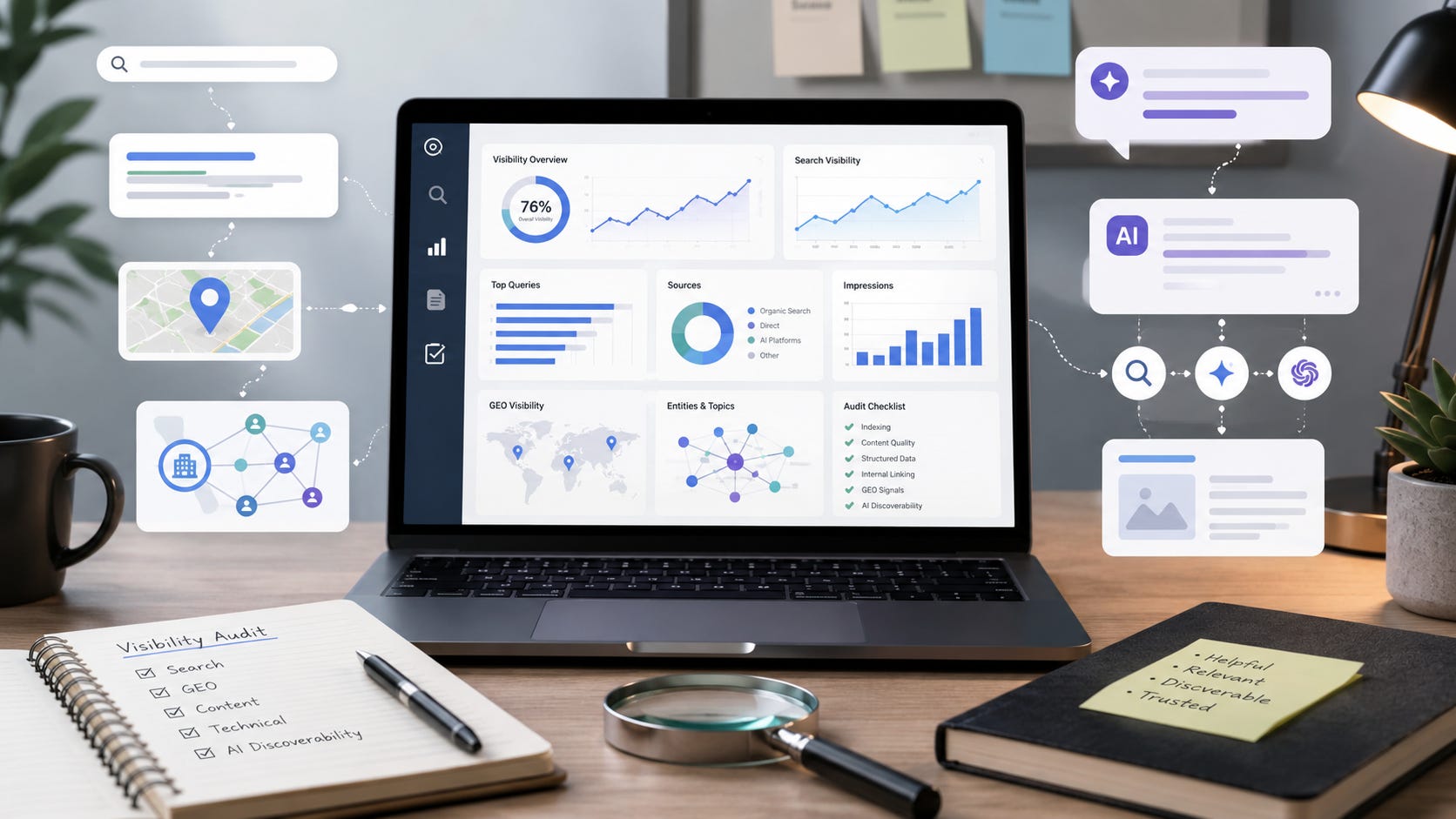
What This Audit Covers
We’re looking at five layers of your visibility:
- Site Clarity — Does your site communicate who you are and what you do, instantly?
- Entity Clarity — Does Google (and AI) know you are a real, trustworthy person or brand?
- Page Structure — Are your pages built in a way that machines can read and cite?
- AI-Citation Readiness — Would an AI reference you in an answer? Why or why not?
- Local + Search Visibility Gaps — Where are you invisible, and why?
Run yourself through each section. Be honest. The gaps you find here are exactly where your next content moves should live.
Read more: Best AI SEO Tools I Actually Use With Clients (Not Every Tool I’ve Tried)
Layer 1: Site Clarity
The test: A first-time visitor lands on your homepage. In 5 seconds, can they answer these three questions?
- Who is this for?
- What do they help me do?
- What should I do next?
If your homepage fails this test, search engines and AI models struggle too. Clarity isn’t just a conversion problem — it’s a crawlability problem.
Audit questions to ask yourself:
- Does your above-the-fold headline name your audience explicitly? (”For freelance writers” beats “Welcome to my blog.”)
- Is there a clear primary call to action — one, not four?
- Does your About page explain your positioning, not just your biography?
- Is your content organized into clear topic clusters, or is it a chronological dump of posts?
Common gaps: Vague taglines. Missing audience signals. No clear content home base. A portfolio site that looks like a personal journal.
Quick fix: Rewrite your headline as a “I help [specific person] do [specific outcome]” statement. Put it front and center. Update your meta description to match.
Layer 2: Entity Clarity
This is where most small creators and solopreneurs leak visibility without realizing it.
An entity in Google’s world is a real, distinct thing — a person, a brand, a business — with consistent signals across the web. When Google and AI models have enough consistent, corroborating information about who you are, they treat you as authoritative.
When they don’t? You’re a blur.
Audit questions:
- Is your name (or brand name) consistent everywhere — bio, bylines, social profiles, directory listings?
- Do you have a Google Business Profile if you serve local clients or offer services?
- Are you cited, mentioned, or linked to from other credible sites?
- Does your LinkedIn, Twitter/X, or other social bio match your site’s positioning?
- Have you been featured in guest posts, podcasts, or newsletters — with your name and link?
What AI models look for: AI systems trained on web data build associations. If your name appears repeatedly alongside specific topics — content marketing, digital products, solopreneur growth — those associations get reinforced. If you’re scattered, the signal is weak.
Quick fix: Do a “name search” on Google. What comes up on page one? If it’s not you controlling the narrative, that’s your first gap to close. Claim your profiles. Standardize your bio. Start earning mentions.
Read more: 7 SEO Tasks I’d Never Want to Do Manually Again
Layer 3: Page Structure
You can write great content and still be invisible if your pages aren’t structured for machines.
This isn’t about keyword stuffing. It’s about semantic clarity — giving search engines and AI models a clear map of what each page is about.
Audit questions:
- Does every page have one clear H1 that states the topic directly?
- Are your H2s and H3s organized logically (not just for aesthetics)?
- Do your pages answer a specific question a real person would ask?
- Are you using descriptive anchor text in internal links, or just “click here”?
- Do your images have descriptive alt text?
- Are your URLs clean and readable (not /post?id=4821)?
- Do you have a sitemap? Is it submitted to Google Search Console?
The AI-specific angle: Large language models read your content the way a very fast, very literal researcher does. They respond well to content that has a clear structure: a stated problem, organized sections, direct answers, and a logical conclusion. If your posts meander, they won’t be cited.
The hub page strategy: One structural fix worth flagging specifically — instead of burying content five clicks deep (Homepage → Category → Subcategory → Filter → Post), create a strong “hub” page per topic that links directly to your best pieces on that subject. Fewer clicks from your homepage means stronger visibility signals for both Google and AI crawlers. Think of it as flattening your architecture so nothing good gets buried.
Quick fix: Open your top five posts. Check if each one has a clear H1, logical H2 subheadings, and a sentence within the first 100 words that names exactly what the post covers. Fix the ones that don’t.
Layer 4: AI-Citation Readiness
This is the newest layer — and the one most people haven’t thought about yet.
When someone asks an AI assistant “who are some good resources for solopreneurs learning content marketing?” — who gets recommended? It’s not random. AI models pull from sources they’ve seen repeatedly, that are structured clearly, and that demonstrate expertise on a topic.
But here’s something worth understanding first: AI visibility is messier than SEO rankings.
The same prompt can generate different answers depending on timing, model version, location, and phrasing. One user might ask “best newsletter tools for solopreneurs” and another asks “affordable email platforms for one-person businesses” — and those two prompts can surface different results entirely. There’s no single “position one” in AI search. What you’re tracking is patterns, not rankings.
There’s also a difference between being mentioned and being cited. A brand might appear in an AI answer without a link. Another might be linked as a source but not recommended. A competitor might show up in a comparison table. A review site might influence the answer more than your own website does.
That said — here’s the reassuring part. Google themselves have stated that the best path to appearing in AI-generated answers is simply to do good SEO. Strong, clear, crawlable content is the foundation. You don’t need exotic technical tricks.
The factors that make you AI-citable:
- Topical depth: Do you have multiple pieces covering a specific topic from different angles? A cluster of content on, say, “digital products for solopreneurs” beats five disconnected posts on five different topics.
- Clear authorship: Is it obvious who wrote your content and what their credentials or experience are?
- Original perspective or data: AI models are drawn to unique takes, original frameworks, and proprietary observations — not generic summaries.
- Structured, quotable writing: Short, declarative sentences. Clear definitions. Named frameworks or processes. These are easy for AI to surface and cite.
- External validation: Being mentioned on other sites, in newsletters, on podcasts — this corroborates your authority on a topic.
Audit questions:
- Do you have a defined content niche you go deep on — or are you writing about everything?
- Have you named any frameworks, methods, or processes in your writing?
- Do you define key terms in your posts, or assume the reader already knows?
- Is your author bio visible on every piece of content?
Quick fix: Pick your top three topics. Write one “pillar” piece per topic — a comprehensive, well-structured guide that you’d be happy to have an AI recommend. Then build supporting posts around each pillar.
Digital Skills to Income is a reader-supported publication. To receive new posts and support my work, consider becoming a free or paid subscriber.
Read more: The Low-Budget Marketing Channel Playbook: Where to Focus First Based on Your Business Type
A Note on Google AI Overviews Specifically
Google AI Overview is now the first thing many people see when they search. It’s an AI-generated answer block at the top of results — and it links to a handful of reference sources that informed its answer.
Being one of those sources is a significant visibility win. Being absent from it is invisible in a new way.
Research into which sites tend to get cited in AI Overviews shows a clear pattern: sites with strong domain authority, high organic rankings, and solid backlink profiles are more likely to be selected. Pages that already appear as featured snippets are especially well-positioned — optimizing for one tends to help the other.
This doesn’t mean smaller sites can’t get cited. But it does mean the fundamentals matter: high-quality content, clear topic focus, and a consistent publishing presence that builds authority over time.
A quick manual check you can do right now (free): Open a private/incognito browser window and search for questions in your niche. Does Google’s AI Overview appear? Are you or your content cited in it? Who is? This tells you which sites are being treated as authoritative sources in your topic area — and gives you a concrete target list.
Read more: GEO for Small Business: How to Get Cited by AI in 2026
Layer 5: Local + Search Visibility Gaps
Even if you’re a digital-first creator, there are search gaps worth closing — especially if you serve specific industries, regions, or communities.
For local/service-based businesses:
- Is your Google Business Profile complete and active (with posts, photos, and recent reviews)?
- Are you listed in relevant directories with consistent NAP (Name, Address, Phone)?
- Do your service pages use location + service language naturally? (”content strategy for Barcelona-based startups” not just “content strategy”)
For digital creators and solopreneurs:
- Are you showing up for your own name searches? Your newsletter name? Your product names?
- Are competitors ranking for terms you should own — but don’t have content for?
- Are there question-based searches in your niche (”how do solopreneurs find clients”) where you could be the answer?
Search Console is your friend: If you haven’t set up Google Search Console, do it today. It shows you exactly what queries bring people to your site — and which ones you’re showing up for on page two or three (prime opportunity territory).
Quick fix: Go to Google Search Console → Performance → Queries. Filter for queries where your average position is between 8 and 20. These are your “almost there” keywords. Write targeted content or update existing posts to capture them.
Bonus: Tools That Can Help You Track This
You don’t need to run this audit blind. A growing category of tools now helps you see where you stand — both in traditional search and in AI-generated answers. Here’s a quick lay of the land by budget and use case:
For AI search visibility specifically:
- Peec AI — built specifically for tracking brand presence across ChatGPT, Perplexity, and Gemini. Good for teams thinking beyond keyword rankings.
- SearchInsight.ai — tracks visibility across major AI platforms and frames it in terms non-technical people can act on: mentions, citations, competitors, prompt patterns.
- Otterly.AI — a lighter-weight option for solopreneurs and small teams just starting to monitor AI visibility without a big budget commitment.
If you already use SEO tools:
- Semrush and Ahrefs both now include AI visibility features. If you’re already paying for either, check what’s available before signing up for something new.
For free / manual tracking:
- Google Search Console (free, essential) — start here before anything else. Indexing tab tells you what’s being crawled; Performance tab shows what queries are bringing traffic.
- Manual prompt testing — search your category questions in incognito mode across Google, ChatGPT, and Perplexity. Note who appears and who doesn’t. It’s not systematic, but it’s fast and surprisingly revealing.
One important caveat: AI visibility tools are still maturing. Anyone claiming perfect, stable measurement should be treated with skepticism. Results vary by timing, model version, and phrasing. Use these tools to identify patterns — not to obsess over individual answers.
Read more: Generative Engine Optimization: The Complete Guide for SaaS
The Audit Summary Checklist
Use this as a quick score. Mark each item: ✅ Done / ⚠️ Needs work / ❌ Missing
Site Clarity
- [ ] Homepage passes the 5-second test
- [ ] Clear, specific headline naming the audience
- [ ] Single primary CTA
- [ ] Content organized by topic, not just date
Entity Clarity
- [ ] Consistent name and bio across all platforms
- [ ] Google Business Profile (if applicable)
- [ ] At least some external mentions or backlinks
- [ ] Name search returns results you control
Page Structure
- [ ] Every page has one clear H1
- [ ] Logical heading hierarchy (H2s, H3s)
- [ ] Clean URLs and descriptive alt text
- [ ] Sitemap submitted to Search Console
- [ ] No important pages buried more than 3 clicks from homepage
AI-Citation Readiness
- [ ] Defined content niche with topical depth
- [ ] Named frameworks or original perspectives
- [ ] Author bio on every post
- [ ] At least one pillar piece per core topic
- [ ] Appearing (or not) in Google AI Overviews for key topics
Local + Search Visibility
- [ ] Google Search Console active and reviewed
- [ ] “Almost there” keywords identified (positions 8–20)
- [ ] Location/industry signals in content (if relevant)
- [ ] Showing up for your own name and brand terms
Read more: What Is GEO (Generative Engine Optimization)? A Plain English Guide
What to Do With Your Results
If you scored mostly ✅: You’re in good shape. Focus on deepening topical authority and building external mentions.
If you scored mostly ⚠️: You have a foundation — now tighten it. Pick the highest-leverage fix (usually entity clarity or page structure) and spend two weeks there.
If you scored mostly ❌: Don’t panic. Start with site clarity and entity clarity. Everything else builds on those two. One layer at a time.
The Bigger Picture
SEO isn’t dying because of AI. It’s expanding.
The shift happening right now is that visibility is moving from a page-level ranking problem to an entity-level reputation problem. It’s no longer enough to rank at position four. You need to be present in the answer — across search results, AI Overviews, and AI assistant recommendations.
But here’s what’s grounding about all of this: the fundamentals haven’t changed as much as the hype suggests. Clear positioning, well-structured content, topical depth, and consistent external mentions — these have always mattered. AI just makes them matter more visibly, faster.
The creators who win in the next few years won’t need exotic tactics. They’ll build recognizable entities, structure their thinking clearly, and create content deep enough to be worth citing by both humans and machines.
The good news? You don’t need a big budget for this. You need clarity, consistency, and a willingness to audit yourself honestly.
Start with this teardown. Then build from there.
Found a gap you didn’t expect? Hit reply and tell me which layer surprised you most. I read every response.
Did this help? Share it with a fellow solopreneur or creator who’s been wondering why their content isn’t getting found. The audit works best when you can do it together.
If you want a personalized assessment and prioritized action plan, book an AI search consultation.