Most small businesses are not failing because they lack marketing ideas.
They are failing because they are trying to be everywhere at once.
Too many channels. Too little consistency. Too much effort spread too thin.
You post on Instagram on Monday, send a LinkedIn update on Wednesday, try a TikTok on Friday, and wonder why nothing is gaining traction. The problem is not effort. The problem is dilution.
If you are running a business on a tight budget, the goal is not to do more marketing. It is to choose the right 2–3 channels for your specific business type and ignore everything else.
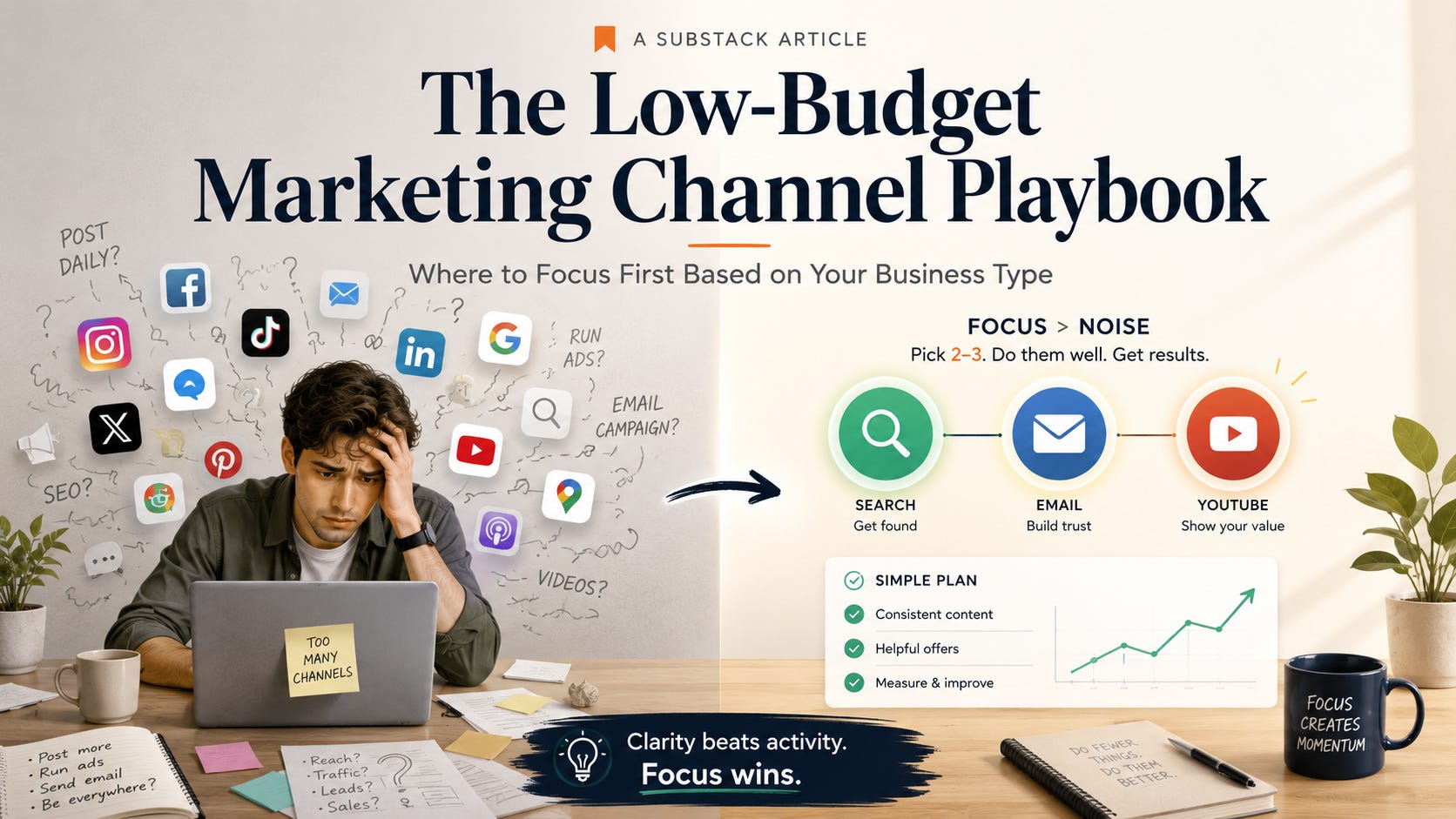
The Real Problem With “Be Everywhere” Advice
Most marketing advice is written for brands with teams, budgets, and content managers. They can afford to run eight platforms simultaneously because they have eight people doing it.
You probably do not.
When a solo founder or small business owner tries to replicate that approach, they end up half-present on every platform and effective on none. A dormant LinkedIn profile, three Instagram posts, an abandoned YouTube channel, and a blog with two articles from 18 months ago.
That is not a marketing strategy. That is a graveyard.
The fix is not a better content calendar. It is a smarter channel selection.
Read more: Generative Engine Optimization: The Complete Guide for SaaS
The Core Principle: Match the Channel to the Buyer
Here is the truth most marketing advice skips:
The best channel is not the trendiest one. It is the one that matches how your buyer discovers, trusts, and buys.
A local dentist and a B2B SaaS founder are not the same buyer. A fashion brand and a management consultant are not the same buyer. The platforms where their customers live, search, and make decisions are completely different.
Which means the right marketing stack for one business is the wrong one for another.
Before you choose any channel, you need to understand one thing: how does your specific buyer go from having a problem to making a purchase?
The Low-Budget Rule
Before we get into business types, here is the rule that makes everything else easier:
For most low-budget businesses, 2 strong channels beat 6 weak ones.
To earn a place in your stack, a channel needs to do at least one of these jobs:
- Capture existing demand — reach people who are already searching for what you offer
- Build trust — give people a reason to believe you before they buy
- Create evergreen visibility — generate traffic or leads that compound over time without constant input
- Generate leads without babysitting — work for you even when you are not actively posting
If a channel cannot do at least one of those things reliably for your business, it does not belong in your stack right now.
Read more: The Lazy SEO Playbook for Low-Budget Founders
The 3 Types of Marketing Channels
Understanding this framework will make the rest of the article much more useful.
Demand capture channels reach people who are already searching for a solution. They have the problem, they know they have the problem, and they are actively looking. Examples: Google Search, SEO, Google Business Profile, YouTube search, Pinterest search.
Trust-building channels help people get to know you over time. Buyers in this zone are aware they have a problem but need more convincing before they commit. Examples: email newsletters, YouTube, LinkedIn, Substack, podcasts.
Attention and discovery channels put you in front of people who were not actively looking for you. Intent is lower here, but reach can be high. Examples: Instagram, TikTok, X/Twitter, Facebook feed, Reddit.
For most low-budget businesses, the order of priority should be: demand capture first, trust second, attention third.
The reason is simple. Demand capture meets buyers where they already are. Trust channels convert them. Attention channels are expensive in time and rarely produce direct revenue early on.
Now let us get into the specifics.
The Business-Type Breakdown
Local Businesses
Med spas, dentists, clinics, salons, plumbers, contractors, restaurants, photographers, and anyone else serving a specific geographic area.
Best channels: SEO + Google Business Profile + Facebook (or Instagram if visual)
Local buyers already have intent. When someone searches “dentist near me” or “best plumber in [city],” they are ready to book. Your job is simply to show up.
SEO and a fully optimised Google Business Profile are non-negotiable. These two work together — your website builds long-term authority, and your GBP puts you on the map literally, capturing searches with immediate purchase intent.
Facebook still works well for local businesses and the 35+ demographic. Local community groups, neighbourhood pages, and targeted ads let you reach people in a specific radius with surprisingly low ad spend. Instagram is worth adding if your business is visual — a restaurant, a salon, a landscape company — but it is optional for everyone else.
What to skip: Trying to build a thought leadership presence on LinkedIn or becoming a content creator on TikTok. Your buyer is not looking for your industry insights. They are looking for availability, reviews, and proximity.
Your starter stack: SEO + Google Business Profile + Facebook
Read more: Case Study: Is Google Ads Still Worth It for Small Businesses in 2026?
B2B Service Businesses
Consultants, agencies, freelancers, coaches, copywriters, SEO specialists, CRM consultants, ops experts, and anyone who sells expertise to other businesses.
Best channels: LinkedIn + SEO (+ email newsletter if you can sustain it)
B2B buyers do not make impulsive purchases. They need credibility, evidence of expertise, and repeated exposure before they trust someone with a real business problem.
LinkedIn is the only social platform where the decision-makers are genuinely present and in a professional mindset. A well-written post about a client problem you solved, a case study, or a contrarian take on a common industry mistake does more selling than any cold email campaign.
SEO complements LinkedIn by capturing the buyers who are already searching for solutions. Service pages optimised for terms like “B2B copywriter for SaaS” or “ops consultant for e-commerce” bring in warm leads who found you on their own terms.
An email newsletter is the highest-leverage trust builder available to B2B service providers. It keeps you top of mind with potential clients who are not ready to buy yet. Most B2B sales cycles are long. A newsletter means you are still in the room six months later when the budget unlocks.
What to skip: Instagram, TikTok, and Pinterest are almost never worth it for B2B services. The audience is there; your buyers are not.
Your starter stack: LinkedIn + SEO, or LinkedIn + newsletter, or SEO + newsletter
Digital Product Businesses
Ebooks, templates, Notion systems, Canva kits, courses, toolkits, and any productised knowledge.
Best channels: SEO + email (+ YouTube or Pinterest depending on the niche)
Digital products typically need three things to sell: search intent, trust before purchase, and repeated exposure. No single channel provides all three, which is why the combination matters.
SEO brings in buyers who are already searching for the problem your product solves. If you sell a Notion productivity system, ranking for “notion template for freelancers” puts your product in front of people in buying mode.
Email does the trust-building work. Because digital products are often lower-ticket, buyers may need less convincing — but they still need some. An email sequence that demonstrates the value of your product and addresses common objections converts much more reliably than a cold landing page visit.
YouTube is worth adding if you can commit to it. Tutorial videos that solve adjacent problems to your product build massive trust and drive evergreen traffic. Pinterest is strong for lifestyle and visual niches — home organisation, recipe planning, fitness, travel — where content can live and accumulate traffic for years.
Your starter stack: SEO + email, or YouTube + email, or SEO + Pinterest for lifestyle/visual niches
Read more: SEO Tips for Founders Who Don’t Have Time (2026 Time-Budget Guide)
SaaS and Micro-SaaS
AI tools, niche software, solo SaaS, small B2B SaaS, and any subscription product.
Best channels: SEO + LinkedIn or YouTube (+ newsletter for retention)
SaaS buyers are often sophisticated. They compare tools, read documentation, watch demos, look at G2 reviews, and take their time. Your marketing needs to match that behaviour.
SEO is the backbone of most successful SaaS growth. Use-case pages, comparison content (”X vs Y”), and “how to solve [problem]” articles capture buyers at every stage of their research. If someone is Googling “best CRM for small agencies,” they are close to a decision. You want to be there.
LinkedIn works well for B2B SaaS because the buyers — managers, operations leads, founders — are there and receptive to product-related content. Demo videos, use-case posts, and problem-aware content all perform well.
YouTube is particularly powerful for SaaS because product explainer videos and tutorials build trust quickly. A five-minute walkthrough of how your tool solves a specific problem does more selling than three weeks of written content.
Reddit is useful for research, not promotion. Read the subreddits where your target users complain about the problems your product solves. Their exact language belongs in your ads, your landing page headlines, and your SEO content.
Your starter stack: SEO + LinkedIn (for B2B SaaS), or SEO + YouTube (for product-led or self-serve SaaS)
Read more: How SaaS Founders Actually Get Their First 10 Customers (Without Ads)
Visual and Consumer Brands
Fashion, home decor, beauty, food, travel, and fitness creators.
Best channels: Instagram + Pinterest (+ email once your audience grows)
These businesses sell through aesthetics, discovery, and repeated visual exposure. The channel selection almost chooses itself.
Instagram remains the strongest discovery platform for visual products. Reels have dramatically extended organic reach, and a well-shot product or lifestyle post can generate saves, shares, and direct traffic. The algorithm rewards consistency and visual quality.
Pinterest is chronically underrated. Content on Pinterest has an unusually long shelf life — a well-optimised pin can drive traffic for years. For home decor, food, fashion, travel, and fitness, it is genuinely one of the highest ROI platforms available.
Email becomes essential once you have an audience. It converts your followers into actual buyers and keeps them in your ecosystem between purchase cycles.
What to skip: LinkedIn and heavy text-first platforms are almost never worth the effort for visual consumer brands unless there is a specific founder-brand story that justifies it.
Your starter stack: Instagram + Pinterest, with email layered in once you have traction
What to Skip (Unless You Have a Very Specific Reason)
A good channel strategy is as much about what you exclude as what you include.
X/Twitter is hard to convert into direct revenue. It is better for building a public personal brand or networking with other founders than for generating leads or sales for most businesses.
Medium can earn search visibility for your writing, but it is a slow burn and rarely the most efficient use of time unless you are specifically trying to build author authority.
Reddit will get you roasted if you try to promote directly. It is a research tool, not a marketing channel. Use it to understand your customers; do not use it to pitch them.
Pinterest is genuinely strong — but only in lifestyle, visual, and inspiration-driven niches. For B2B services or non-visual products, the audience intent does not match.
Instagram is worth nothing for B2B offers that are not visually compelling. A consultant posting corporate headshots and infographics is not going to build a pipeline there.
LinkedIn is irrelevant if your buyers are not professionals or business decision-makers. Local businesses and consumer brands rarely need to be there.
The rule: do not be on a platform just because other people are. Be there because your buyer is there in a way that is useful to you.
A Simple Decision Framework
Before committing to any channel, run it through these three questions:
- Where does my buyer already search when they have this problem? This tells you your demand capture channel.
- Where does my buyer need to see me repeatedly before they trust me enough to buy? This tells you your trust channel.
- Which channel can I realistically maintain with my current time and budget? This is the filter that makes the strategy executable.
The best channel strategy is not theoretical. It has to match both buyer behaviour and your actual capacity to show up consistently.
A channel you can sustain at 70% effort beats a channel you abandon after six weeks.
Read more: Generative Engine Optimization: The Complete Guide for SaaS
Your Starter Stacks at a Glance
Business Type
Recommended Stack
- Local business
- SEO + Google Business Profile + Facebook
- B2B service
- LinkedIn + SEO
- Digital product
- SEO + Email
- SaaS
- SEO + LinkedIn or YouTube
- Visual / consumer brand
- Instagram + Pinterest
- Personal brand / expert
- Newsletter + LinkedIn or YouTube
The Most Common Mistakes
Trying to be everywhere. The biggest one. Pick fewer channels and do them properly.
Choosing channels based on trend, not buyer behaviour. TikTok is growing fast. That does not mean your B2B consulting firm needs to be on it.
Confusing attention with demand. Getting followers is not the same as getting customers. Many businesses have large audiences on channels that generate almost no revenue.
Posting on platforms you hate. If you resent every post you make, you will not make them consistently. Consistency matters more than channel selection in the long run.
Building for reach before building for trust. Growing an audience before you have built credibility is backwards. Trust compounds. Viral moments do not.
Ignoring search channels if your buyers already search. This is the most expensive mistake. If people are actively Googling for what you sell, not showing up there is leaving money on the table every single day.
The Big Lesson
Low-budget marketing gets easier when you stop asking: “Where should I be?”
And start asking: “Where does my buyer already look, trust, and act?”
The goal is not to win every platform. The goal is to choose a few channels that match how your specific buyer discovers and makes decisions — and then show up there well enough, consistently enough, that it actually compounds.
Two channels done properly will outperform six channels done poorly. Every time.
Pick your two. Go deep. Let the rest wait.
Explore my GEO and AI SEO consulting service to see how I evaluate entity clarity, technical readiness, content structure, authority signals, citations, and competitor visibility.
If you want a personalized assessment and prioritized action plan, book an AI search consultation.
Have a question about which channels fit your specific business? Reply and let me know what you do I read every response.