You built the product. You have users. You have traffic.
And you still don’t have a pipeline.
This is the most common and most frustrating place for a SaaS founder to be. Everything on the surface looks like progress. Signups are coming in. People are exploring the product. A few are even using it.
But qualified leads? Demos? Consistent, predictable revenue?
That part is not working.
If this sounds familiar, you don’t have a product problem. You have a lead generation problem. And the good news is: it is fixable. But only if you understand what is actually causing it.
This guide breaks down how SaaS lead generation actually works, where most founders go wrong, and what a functional lead generation system looks like at the early stage — without burning money on ads.
Why Most SaaS Products Quietly Die Without Leads
Most SaaS products do not fail dramatically. There is no single moment where everything collapses.
Instead, they die slowly. Traffic comes in but doesn’t convert. Signups accumulate but don’t activate. Interest is there, but intent is absent. The product keeps running, the founder keeps building, and one day it becomes clear that activity was never the same as growth.
The root cause is almost always the same: attention was mistaken for demand.
A thousand site visits is not a pipeline. A hundred free signups is not buying intent. Five people telling you the product is interesting is not a qualified lead.
Lead generation is the system that turns strangers into real buyers — people who have the problem, know they have the problem, are willing to pay to solve it, and are actually entering your world consistently enough to create revenue.
Without that system, even a strong product stalls.
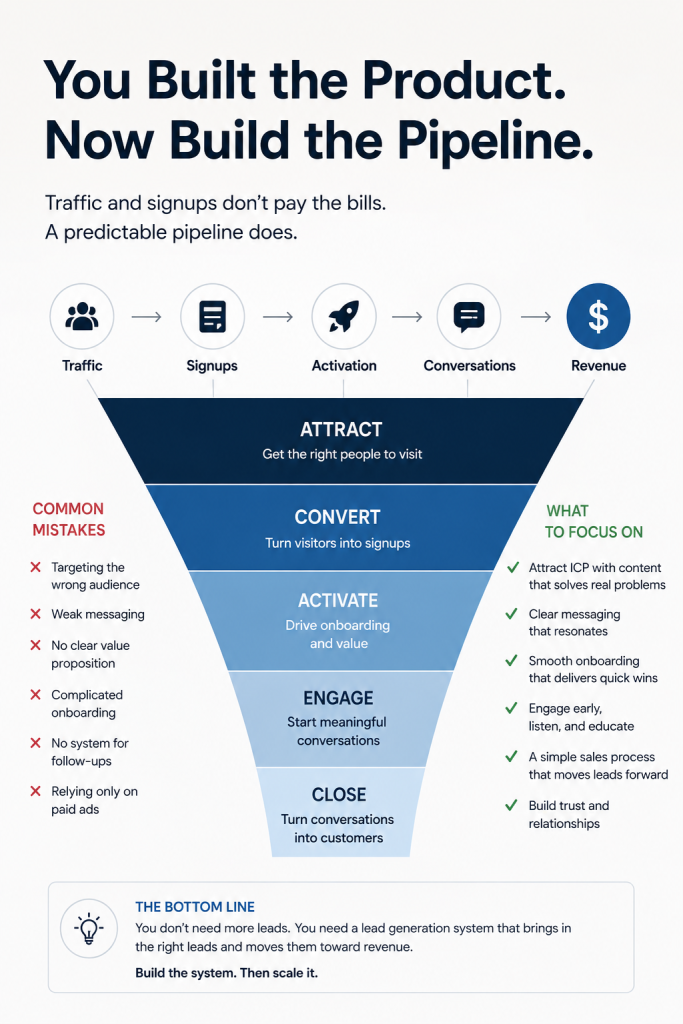
The Real Definition of a SaaS Lead
Before building a lead generation system, it helps to be clear about what a lead actually is.
In SaaS, there are three types that matter:
Marketing Qualified Lead (MQL): Someone who fits your ideal customer profile and has shown some interest — downloaded a resource, visited your pricing page, signed up for a newsletter. They are aware of you. They have not signalled intent to buy.
Sales Qualified Lead (SQL): Someone who has shown buying intent — requested a demo, asked about pricing, booked a call. This is who you are ultimately trying to generate.
Product Qualified Lead (PQL): A user already inside your product who has experienced enough value to be statistically likely to convert to paid. If you have a freemium or free trial model, this is your most valuable lead type.
Most early-stage founders conflate these. They celebrate MQL numbers while their SQL pipeline stays empty. A lead generation system that works connects all three stages — and moves people through them.
Where SaaS Lead Generation Actually Breaks Down
There are five places where most early-stage SaaS lead generation falls apart.
1. Targeting visibility instead of intent
SEO traffic, social followers, and newsletter subscribers are not leads. They are an audience. An audience becomes a pipeline when the right people — those with the specific problem your product solves — are consistently entering your world with a reason to pay attention.
Chasing reach before building for intent is the most common early-stage mistake. It produces vanity metrics and empty pipelines.
2. Not knowing who the buyer actually is
“Small businesses” is not an ideal customer profile. “Ops managers at B2B SaaS companies with 10–50 employees who are manually tracking client onboarding in spreadsheets” is.
The more specific your buyer definition, the easier every part of lead generation becomes — the channel you use, the content you create, the copy on your landing page, the way you handle a demo call.
Without a specific ICP, your messaging tries to speak to everyone and resonates with no one.
3. Building for features instead of problems
Most SaaS landing pages describe what the product does. The buyer does not care what the product does. They care about the problem they are living with right now and whether someone understands it well enough to solve it.
Lead generation starts failing the moment you lead with features instead of the pain your buyer is trying to get rid of.
4. No system for following up
Most SaaS leads require multiple touchpoints before they convert. Research consistently shows that B2B buyers need repeated exposure before they make a decision. A single visit to your website, a single email, a single LinkedIn post — none of these are enough on their own.
Without a nurture system — an email sequence, a retargeting approach, a newsletter — leads fall out of your world before they are ready to buy.
5. Depending entirely on paid acquisition
Paid ads can accelerate lead generation, but they are not a foundation. For early-stage SaaS, paid ads with unclear positioning, untested messaging, and no organic foundation tend to produce expensive, low-quality traffic.
The founders who build durable pipelines build organic systems first: content, SEO, LinkedIn, email. Paid comes later as an amplifier, not a substitute.
The 4 Pillars of a SaaS Lead Generation System
A lead generation system is not a collection of tactics. It is a connected set of channels and mechanisms that works together to bring the right people in, build enough trust to create intent, and move them toward a buying decision.
Here is what that looks like for early-stage SaaS.
Pillar 1: Demand Capture
Demand capture channels reach people who are already searching for the problem you solve. They have intent. Your job is to show up when they look.
For SaaS, this means:
- SEO and content — ranking for the terms your buyers type into Google when they have the problem. “How to automate client onboarding,” “best tool for B2B ops teams,” “[competitor] alternative.” These are buyer-intent searches. Showing up here puts you in front of people already in the market.
- Google Business Profile is less relevant for pure SaaS, but for SaaS with a local or service component, it matters.
- Comparison and review platforms — G2, Capterra, Product Hunt. Buyers researching your category visit these. A strong presence converts searchers who are already close to a decision.
Pillar 2: Trust Building
Most SaaS buyers do not convert on the first visit. They need time, evidence, and repeated exposure.
Trust-building channels keep you present with potential buyers while they are still deciding:
- Email newsletter — the highest-leverage trust channel available to early-stage SaaS founders. It keeps you visible with people who are not yet ready to buy. B2B sales cycles can be months long. A newsletter means you are still in the room when the budget unlocks.
- LinkedIn — where B2B decision-makers actually spend time. Founder-led content about the problem your product solves builds credibility faster than almost any other channel. Authenticity is still an advantage at the early stage.
- YouTube — slower to build but extremely durable. A product walkthrough, a tutorial solving the problem your product addresses, or a breakdown of a common pain point builds trust at scale. A video from two years ago still books demos today.
Pillar 3: Lead Magnets and Conversion Points
Traffic and trust alone do not create leads. You need specific moments where a potential buyer takes a step toward becoming a customer.
For SaaS, effective conversion points include:
- A free trial or freemium tier — the product itself as a lead magnet
- A demo request — for sales-led products
- A lead magnet — a guide, framework, or resource that solves a specific problem for your buyer and earns their email address
- A waitlist or early access — for pre-launch or new features
The best lead magnets are not generic. They solve a specific, concrete problem for a specific buyer. “The 5-step framework for automating client onboarding without custom code” converts better than “Free SaaS growth tips.”
Pillar 4: Nurture and Follow-Up
Most leads are not ready to buy the day they find you. A nurture system keeps the conversation going until they are.
For early-stage SaaS, this means:
- An onboarding email sequence that moves free users toward activation
- A nurture sequence for MQLs that builds the case for your product over time
- Consistent newsletter content that demonstrates expertise and keeps you top of mind
- LinkedIn follow-up for people who engaged with your content but haven’t converted
The goal of nurture is simple: when a lead becomes ready to buy, you are the first product they think of.
Channel Recommendations by Stage
Not every channel makes sense at every stage. Here is a practical starting point.
Pre-revenue / very early stage:
- LinkedIn (founder-led content about the problem space)
- Direct outreach to your ICP with a specific, problem-led message
- A simple email sequence for early signups
Early traction ($0–$10K MRR):
- SEO content targeting buyer-intent keywords
- LinkedIn consistently
- Email newsletter for lead nurture
- One lead magnet tied directly to your ICP’s biggest pain point
Growing ($10K–$50K MRR):
- Double down on what is already working
- Add YouTube if you can commit to consistency
- Begin testing paid amplification on your best-performing organic content
- Build a structured demo → follow-up sequence
The Mistake That Kills Early-Stage Lead Generation
Here is the one that causes the most damage: treating lead generation as a campaign instead of a system.
A campaign has a start and an end. You run ads for a month, you publish a burst of content, you do a LinkedIn push. The campaign ends. The leads stop.
A system keeps running. It compounds. A blog post you wrote eight months ago still brings in traffic. A YouTube video from last year still books demos. An email sequence you built once still nurtures every new signup automatically.
The difference between a SaaS product that quietly dies and one that builds a real business is almost always whether the founder built a system or ran a series of campaigns.
What a Real Lead Generation System Looks Like
Here is a simple, realistic lead generation setup for an early-stage SaaS founder:
Demand capture: 2 SEO articles per month targeting buyer-intent keywords. A presence on G2 or Capterra with reviews.
Trust building: A weekly or bi-weekly LinkedIn post about the problem you solve. A simple email newsletter going out once a week or twice a month.
Conversion point: A lead magnet — a practical guide or framework that solves a specific problem for your ICP — gated by email. A clear demo request CTA on the pricing page.
Nurture: A 5-email welcome sequence for new signups. Monthly newsletter content that demonstrates your thinking and keeps you top of mind.
That is not a complex system. But it is a connected one. Each part feeds the next. And over six to twelve months, it compounds into a real pipeline.
The Honest Summary
SaaS lead generation is not complicated in theory. You find where your buyers already are, you show up with something useful, you build enough trust that they consider you, and you give them a clear path to becoming a customer.
What makes it hard is that most founders skip one or more of those steps — usually trust-building and nurture — and then wonder why traffic isn’t turning into revenue.
The solution is not more ads. It is not a better landing page headline. It is not another feature.
It is building a system that works end-to-end. One that captures the right people, earns their trust, and moves them toward a buying decision consistently enough to create predictable growth.
Want the Complete System?
If you are an early-stage or AI SaaS founder dealing with exactly this problem — getting traffic but not demos, getting signups but not sales, getting attention but not qualified leads — I put the complete framework into a practical guide.
Why Most SaaS Products Fail Without Leads: The Complete System for Predictable Growth covers everything in this article in much more depth, with concrete frameworks you can apply to your specific product.
No hype. No vague advice. Just a more honest, practical way to fix the lead problem before it kills the product.
Written by a certified marketer with 15 years of experience helping SaaS founders and early-stage companies build lead generation systems that actually work.