Find the words your customers actually use
Start here: intent before volume
Many solo business owners make the same mistake: they choose a keyword because a tool shows a big search number.
But a high-volume keyword is not automatically the best business opportunity.
In this part, broad phrases such as “content marketing” and “marketing strategy” have very large search demand, while more specific phrases such as “content marketing for small businesses” or “marketing ideas for small business” have much lower volume. But for a solo business owner, those narrower searches can be far more useful because the audience and problem are much clearer.
For example:
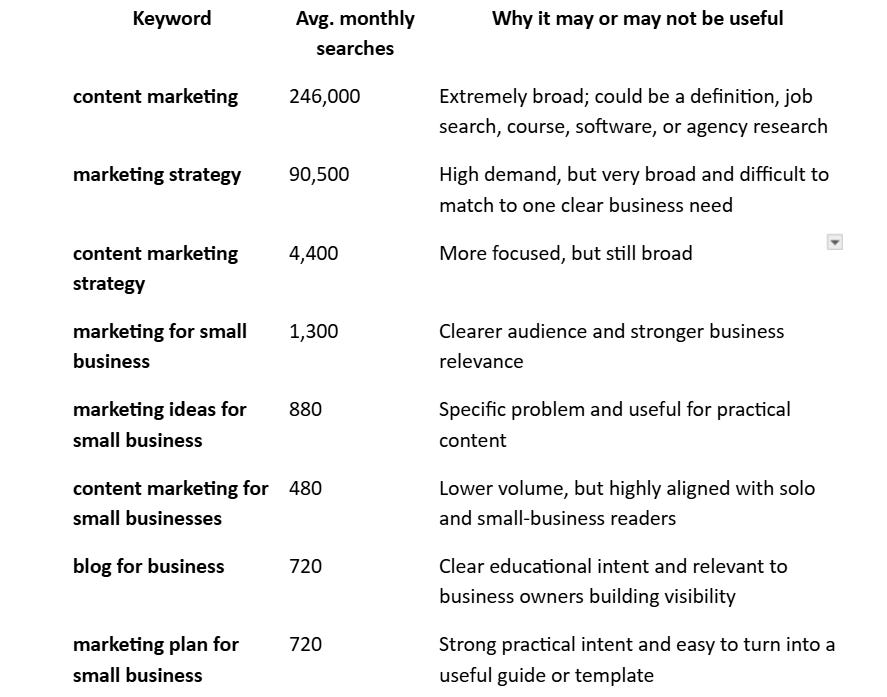
Strong practical intent and easy to turn into a useful guide or template
The lesson is simple:
A smaller keyword can be more valuable when the person behind the search looks more like your ideal reader or customer.
For a solo business owner, 50 relevant visitors who are trying to improve their content or grow their business can be more useful than thousands of visits from people searching a broad topic with no clear intent.
Step 1: Start with the problem you already help people solve
Do not begin by opening a keyword tool and choosing whatever has the biggest number.
Start with the problems your audience already talks about.
For this Substack audience, those might be:
- I don’t know what content to create.
- I’m posting but not attracting clients.
- I need a simple marketing strategy.
- I want to build visibility without a big budget.
- I don’t know how to turn content into leads.
- I need a realistic content plan for my small business.
Now search around those problems.
This keeps your keyword research connected to your actual business.
Step 2: Look for the more specific version of the broad topic
Suppose you start with:
marketing strategy
The data shows very high demand.
But it is too broad to tell us who the searcher is or what they actually need.
Move one level deeper:
marketing strategy for small business
Now we know the audience.
Go another level deeper:
marketing plan for small business
Now the search becomes more actionable.
That progression looks like this:
Marketing strategy
↓
Marketing strategy for small business
↓
Marketing plan for small business
The further down you go, the smaller the volume may become, but the intent usually becomes easier to understand.
Step 3: Identify the search intent
Now ask:
What is this person actually trying to do?
Informational
They want to learn something.
Examples:
“content marketing what is”
“content marketing examples”
“blog for business”
Good formats:
- article
- tutorial
- guide
- FAQ
Commercial
They are evaluating possible approaches, tools, or services.
Examples:
“content marketing tools”
“tools for content marketers”
“best marketing strategy”
Good formats:
- comparison
- review
- buyer guide
- recommendation article
Transactional
They are closer to paying for help.
Examples from the data:
“content marketing services”
“small business marketing services”
“content creation services”
Good formats:
- service page
- consultation page
- product page
- booking page
Navigational
They are searching for a particular company, creator, or publication.
For your own brand, this could eventually be something like:
“Digital Skills to Income Substack”
or your personal name + service.
Good format:
- homepage
- About page
- publication page
Step 4: Look for keywords that match your reader
This is where your persona becomes important.
You do not need to create content for every keyword in the export.
Ask:
Would the person searching this realistically benefit from my newsletter, product, or service?
For your audience, these are much more aligned:
- content marketing for small businesses
- marketing strategy for small business
- marketing ideas for small business
- marketing plan for small business
- blog for business
- website content strategy
- content strategy framework
- content marketing examples
- content marketing tools
- content distribution
These are closer to the problems you already teach around:
visibility, content systems, audience growth, and turning digital skills into income.
A keyword such as “content creation agencies” may have much higher volume, but it is probably less relevant for this article because the searcher may simply be looking to hire an agency.
That is why relevance comes before volume.
Step 5: Group similar keywords instead of creating one page for each
Keyword tools often show many phrases that mean almost the same thing.
For example:
- content marketing strategy
- marketing content strategy
- content marketing and strategy
- content strategy
- content strategy framework
You do not need five different articles.
You could create one strong guide around:
How to Build a Simple Content Marketing Strategy
Inside it, you could naturally answer:
- what a content strategy is
- how to create one
- what framework to use
- how a small business should approach it
- examples of simple strategies
Think in topics, not isolated keywords.
Step 6: Match the keyword to the right content format
This is one of the most useful parts of keyword research.
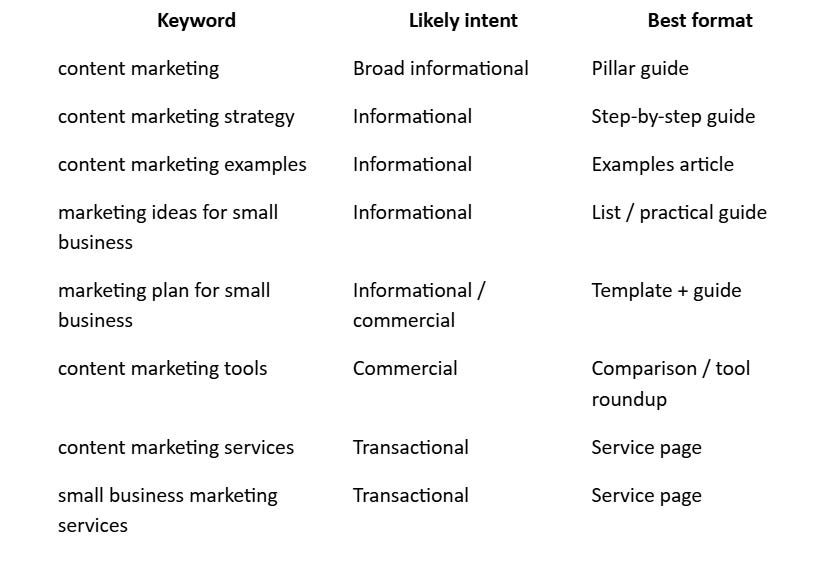
Do not try to rank a newsletter article for a strongly transactional search if a service page would answer it better.
And do not turn every educational keyword into a sales page.
The page should match the reason behind the search.
A simple rule
- Use informational keywords to build trust and attract people earlier in their journey.
- Use commercial and transactional keywords on your service, product, audit, or booking pages.
- Use navigational keywords to make your own brand easy to find.
Step 7: Find the realistic opportunity
Now compare a few options.
Option A
content marketing
246,000 average monthly searches.
Huge demand.
But extremely broad.
Option B
content marketing strategy
4,400 average monthly searches.
Still competitive, but much clearer.
Option C
content marketing for small businesses
480 average monthly searches.
Smaller demand, but directly aligned with your target reader.
For your Substack, I would probably choose Option C before Option A.
Why?
Because the person searching it looks much more like the person you actually want to attract.
That is the difference between traffic and useful traffic.
Step 8: Turn the keyword into a human question
The keyword is not your article title.
Translate it into the actual question behind the search.
Keyword:
content marketing for small businesses
Human question:
How can a small business use content marketing without a big team or budget?
Keyword:
marketing plan for small business
Human question:
What should a simple marketing plan actually include for a one-person business?
Keyword:
content marketing tools
Human question:
Which content tools are actually worth using when you work alone?
This makes your content more natural, useful, and much closer to how people now search across both Google and AI tools.
Your exercise
Choose one problem your ideal reader has.
Then:
- Find 10–20 related keywords.
- Remove anything that does not match your audience.
- Group similar phrases together.
- Label the intent.
- Compare broad keywords with more specific ones.
- Pick one topic where relevance and intent are strong.
- Match it to the right content format.
- Rewrite the keyword as a real customer question.
For example:
Keyword: content marketing for small businesses
Volume: 480/month
Intent: Informational
Audience: Small/solo business owners
Best format: Practical guide
Real question: How can a small business do content marketing without a large team or budget?
Decision: Strong topic for this audience.
That is the kind of keyword decision I want a solo business owner to learn to make.
I built the keyword research sheet here, so you can download:
The workbook includes:
- Priority Keywords — 250 strongest opportunities with volume, intent, funnel stage, focus, competition, bids, persona fit, specificity, business relevance, priority score, content format, and a human-style question
- All Relevant Keywords — 1,340 filtered keywords from both files
- Topic Clusters — grouped themes such as Content Marketing, Small Business Marketing, Blogging, SEO, Creator Growth, and more
- Course Example — the exact type of examples you can use inside your article
- How to Use — simple instructions for solo business owners
The priority score is formula-based and weighs persona fit + specificity + business relevance + intent + demand + competition.
substack_content_marketing_keyword_research
The fastest way to identify intent: read the Google results
Do not rely only on what you think the keyword means.
Google’s first page shows what it believes searchers want.
Before choosing a keyword:
- Open an incognito/private browser window.
- Search the phrase.
- Look at the first 5–10 results.
- Ask:
- Are the results articles, videos, product pages, local maps, or service pages?
- Are they beginner guides, comparison lists, or companies offering a service?
- Do they answer a question, help people compare options, or ask people to buy?
- Are there “People also ask” questions?
- Do the results match the page I was planning to create?
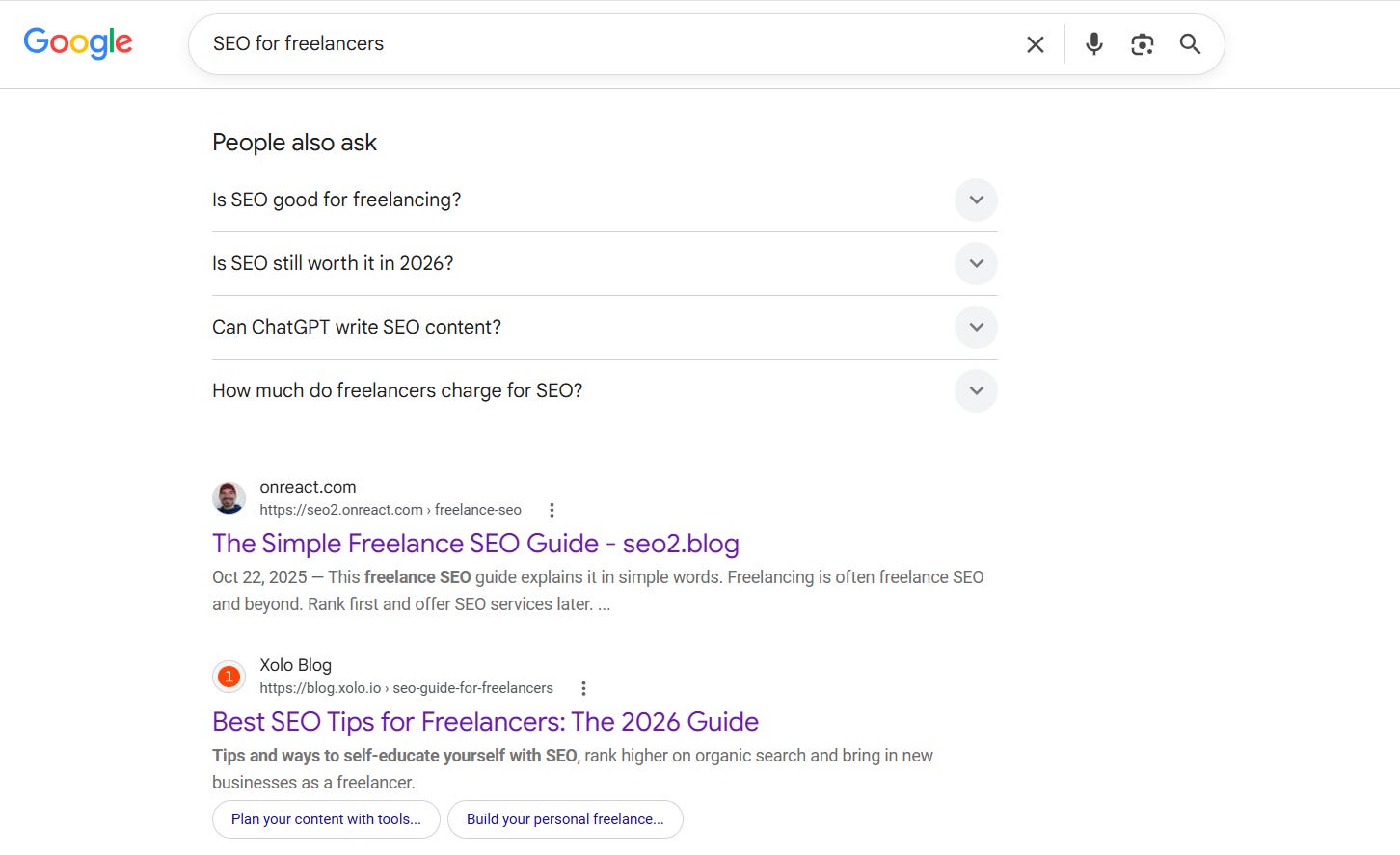
Example
If you search:
“SEO for freelancers”
And Google shows mostly guides, checklists, and blog posts, the intent is likely informational.
Do not create a hard-selling service page and expect it to rank for that phrase. Create a useful guide first, then include a relevant CTA such as a checklist, audit, or consultation.
If you search:
“SEO consultant for freelancers”
And Google shows agencies, consultants, service pages, and local listings, the intent is commercial or transactional.
That is a better phrase for a service page.
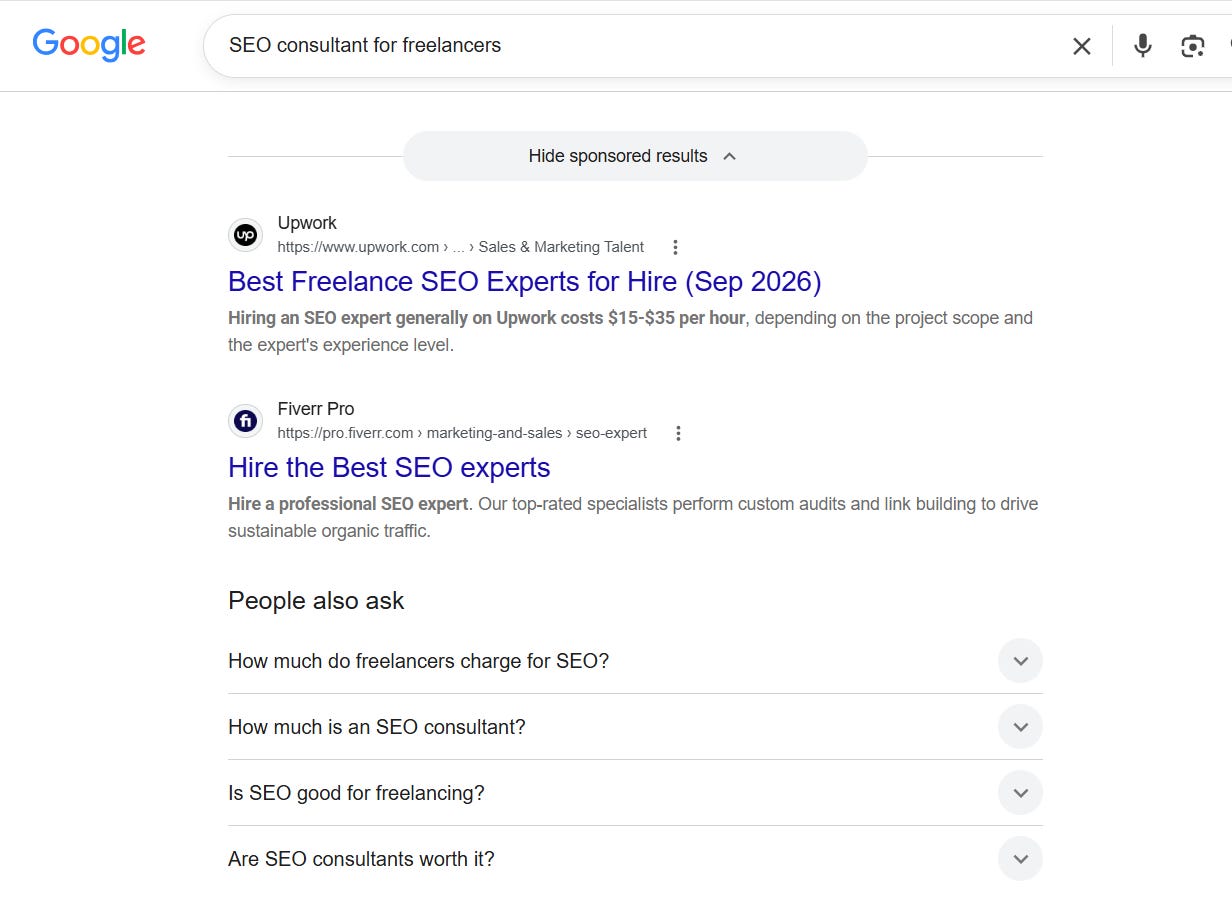
The live search results are your best free intent research tool.
Step 1: Start with your customers not a tool
Before opening a keyword tool, make a “seed topic” list.
Seed topics are not your final keywords. They are the broad topics, services, problems, and outcomes that help you find better search opportunities.
Let’s use a realistic persona:
Solo SEO/GEO consultant helping small businesses and creators get found on Google and AI search.
Step 1: Start with the business, not the keyword tool
Before searching for keywords, write down what the business actually does.
For this example, the consultant helps with:
- SEO for small businesses
- Local SEO
- AI search visibility
- GEO
- Content strategy
- SEO audits
- Google Business Profile
- Search Console
- Substack SEO
- Website visibility
- Getting mentioned by ChatGPT
- Keyword research
These are not final keywords yet.
They are seed topics.
Step 2: Group the seed topics into 4 buckets
A. What you sell
These are the services or products people can actually buy.
For example:
- SEO audit
- Local SEO service
- GEO audit
- AI visibility audit
- SEO consulting
- Content strategy
- Keyword research
- Google Business Profile optimization
- Substack SEO consulting
This gives you commercial seed topics.
B. Problems your customers have
Now write down the problems people come to you with.
For example:
- website not getting traffic
- not showing up on Google
- not ranking in Google Maps
- ChatGPT recommends competitors
- content not getting found
- low organic traffic
- local business not appearing near me
- Google Business Profile not ranking
- no leads from SEO
- website indexed but not ranking
- AI describes business incorrectly
- blog gets impressions but no clicks
These are often even better than service names because they reflect real search behavior.
C. Outcomes they want
Now ask:
What does the customer actually want to achieve?
Examples:
- get more traffic from Google
- rank higher locally
- get more leads from organic search
- appear in Google Maps
- get mentioned by ChatGPT
- improve AI visibility
- get more clicks from search
- grow a Substack with SEO
- attract clients through content
- make a small business easier to find online
These give you outcome-based seed topics.
D. Who the customer is
Now add the audience.
For example:
- small business
- solo business owner
- freelancer
- consultant
- creator
- Substack writer
- therapist
- dentist
- plumber
- SaaS founder
- local business
- coach
Now you can combine audience + problem or audience + service.
Step 3: Combine the seeds
This is where the useful keyword ideas start appearing.
For example:
Service + audience
- SEO for small business
- local SEO for therapists
- SEO for consultants
- SEO for Substack
- GEO for small business
- AI visibility for SaaS
Problem + audience
- why is my small business website not getting traffic
- why is my Substack not showing up on Google
- why is my business not appearing in Google Maps
- why does ChatGPT recommend my competitor
Outcome + audience
- how to get more traffic to a small business website
- how to rank a local business on Google
- how to get mentioned by ChatGPT
- how to grow a Substack with SEO
Service + problem
- local SEO audit for poor Google Maps rankings
- SEO audit for low organic traffic
- AI visibility audit for incorrect brand mentions
Step 4: Turn the list into a proper seed sheet
At this stage, your sheet might look like this:
Seed topic
Type
Audience
Problem/Goal
SEO audit
Service
Small business
Find visibility issues
Local SEO
Service
Local business
Rank in Maps
GEO audit
Service
SaaS / small business
Improve AI visibility
SEO for Substack
Service
Creator
Get articles found
Website not getting traffic
Problem
Small business
Increase organic traffic
ChatGPT recommends competitors
Problem
Business owner
Improve AI mentions
Google Business Profile not ranking
Problem
Local business
Improve local visibility
Get mentioned by ChatGPT
Outcome
Business owner
AI discovery
Get more organic leads
Outcome
Consultant
Revenue growth
Grow Substack with SEO
Outcome
Creator
Audience growth
Step 5: Only now open the keyword tool
Now you take these seed topics into:
- Google Keyword Planner
- Ahrefs
- Semrush
- Google Search Console
- Google autocomplete
- YouTube
- ChatGPT or another AI tool for expansion
The tool’s job is to help you expand and validate the seeds.
It should not decide your strategy for you.
The simple formula
A strong seed list usually comes from:
What you sell
- What people struggle with
- What they want
- Who they are
That is a much better starting point than typing one random word into a keyword tool and chasing the biggest search volume.
A nice closing line for your article:
Your keyword tool should expand your thinking, not replace it. Start with the customer. Then use the tool.
Step 2: Use free research sources
You do not need an expensive SEO subscription to get started.
Use these free sources in this order.
1. Google autocomplete
Start typing your seed topic into Google without pressing Enter.
Google will suggest phrases that people commonly search for.
Example:
text
SEO for…
SEO for freelancers
SEO for small business
SEO for consultants
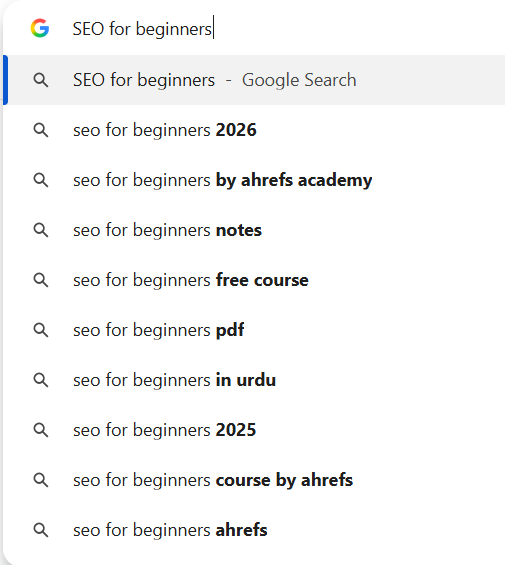
SEO for beginners
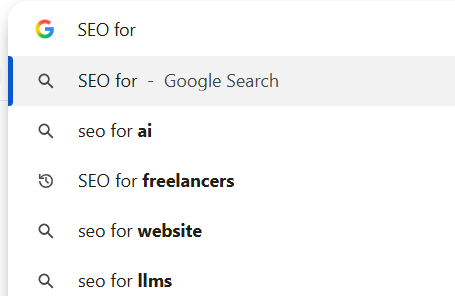
Write down only suggestions that are relevant to your business and audience.
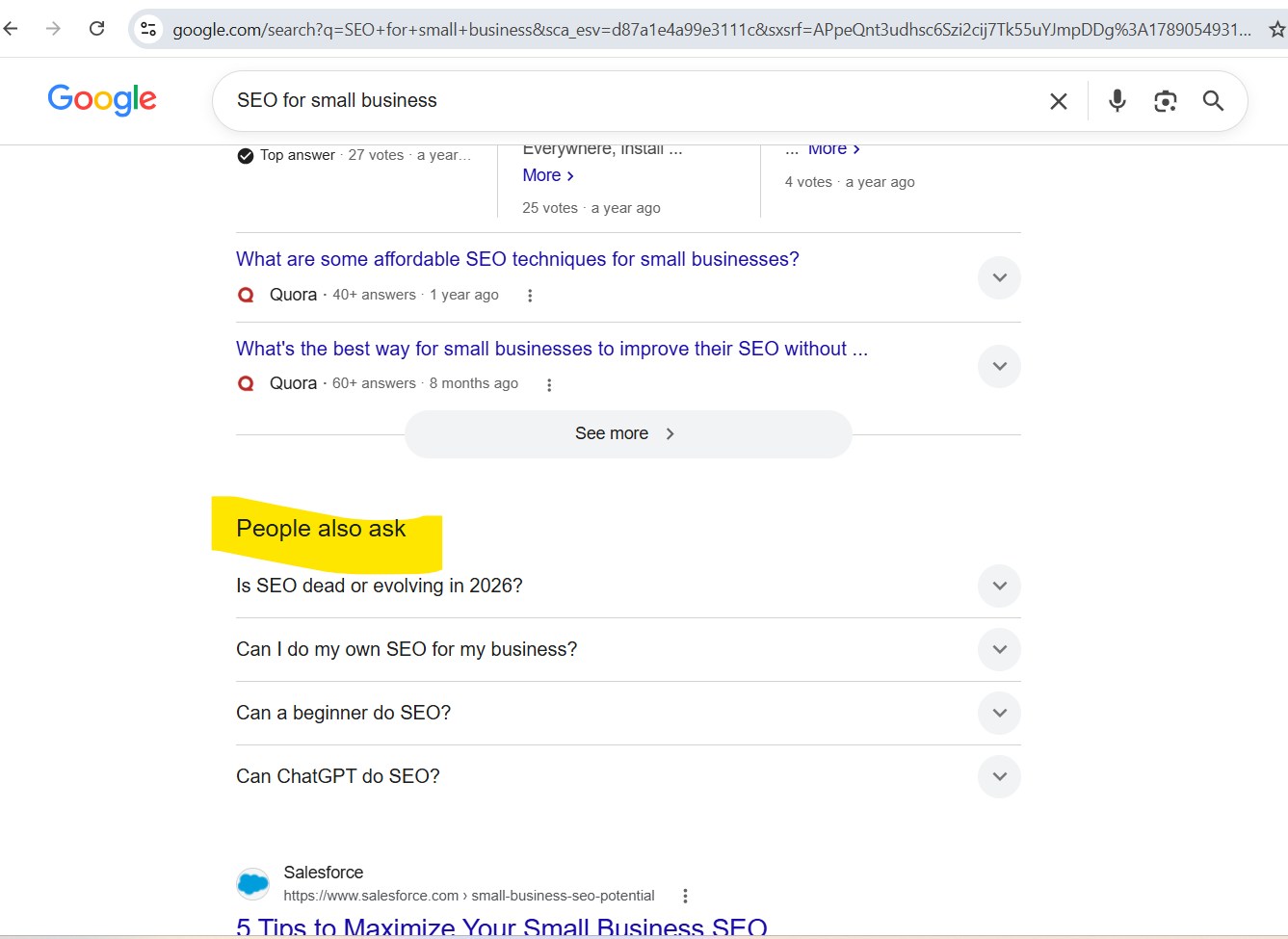
2. People Also Ask
Search your seed topic and look for the “People also ask” questions.
These questions help you understand:
- What people are confused about.
- What subtopics belong in your article.
- What related articles you could create later.
- The exact language searchers use.
Example questions around “SEO for small business” may include:
- Is SEO worth it for a small business?
- How much does SEO cost for a small business?
- Can I do SEO myself?
- How long does SEO take to work?
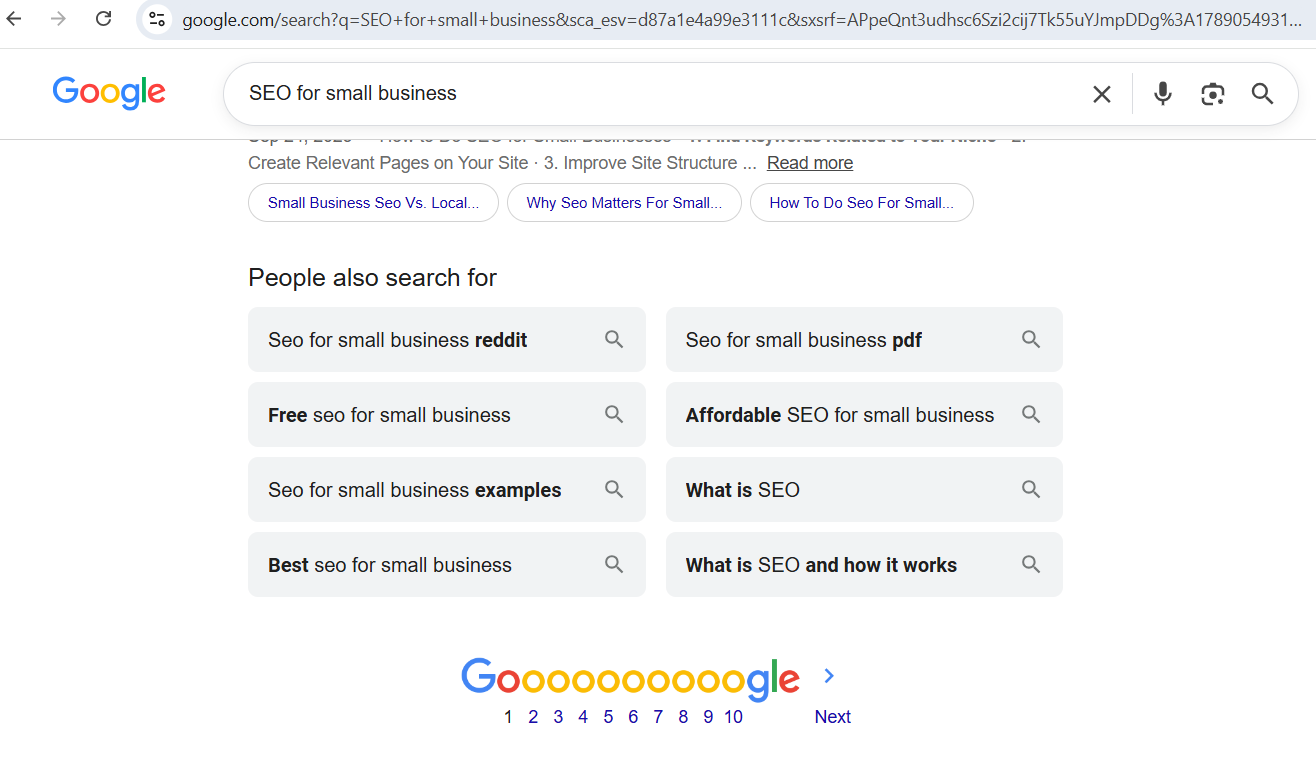
3. Related searches
Scroll to the bottom of a Google results page.
The related searches section gives you additional phrases and angles that Google connects to the topic.
Use this to expand your seed list, not to copy every term into one page.
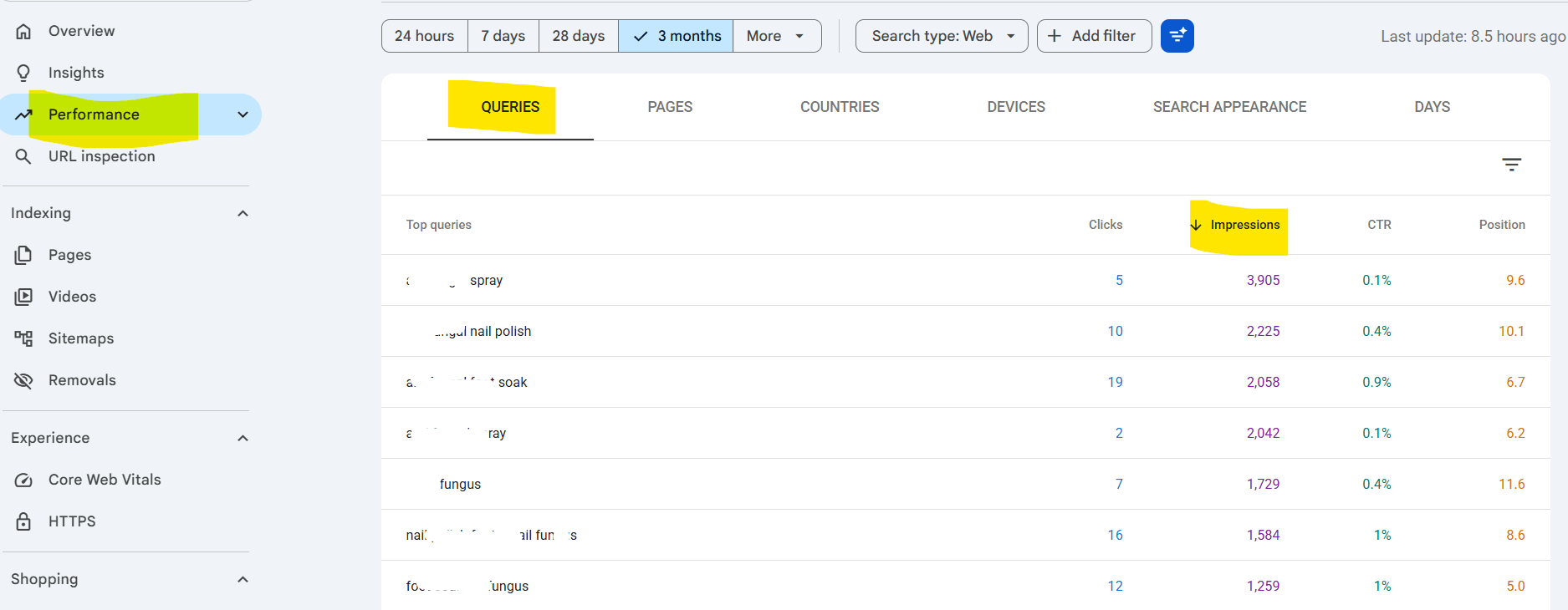
4. Google Search Console
If you already have a website or Substack custom domain connected to Search Console, this is your most valuable free source.
Go to:
Performance → Search results → Queries
Look for:
- Queries getting impressions but few clicks.
- Queries where you rank around positions 8–20.
- Questions that are relevant but not answered well on your current site.
- Phrases that surprise you—because they reveal how Google and searchers already understand your content.
Queries in positions 8–20 are especially valuable. Google already sees some relevance, so improving the existing page is often faster than starting a new article from zero.
Search Console’s Performance reports show which queries and pages are generating impressions and clicks, helping you identify content opportunities grounded in your own site’s real search data.support.google+1
5. Your audience communities
Use communities to collect language, not just topic ideas.
Look at:
- Reddit.
- Quora.
- Facebook groups.
- LinkedIn comments.
- YouTube comments.
- Substack Notes and comment threads.
- Product reviews.
- Community forums in your industry.
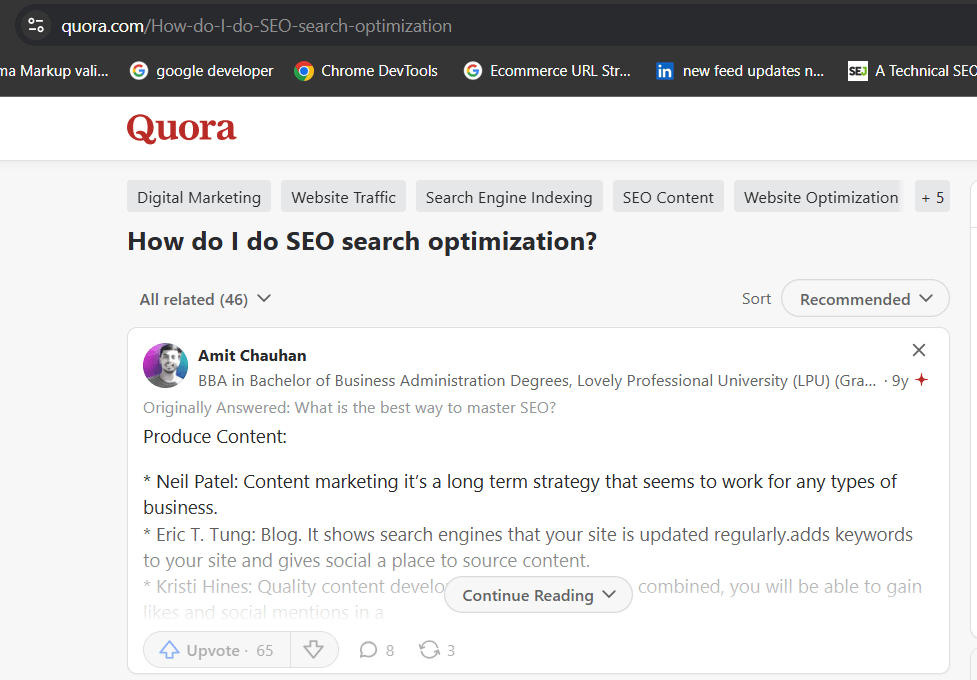
Pay attention to sentences that start with:
- “How do I…?”
- “Why is…?”
- “I am struggling with…”
- “What is the best way to…?”
- “Does anyone know…?”
- “Should I hire…?”
- “Is it worth…?”
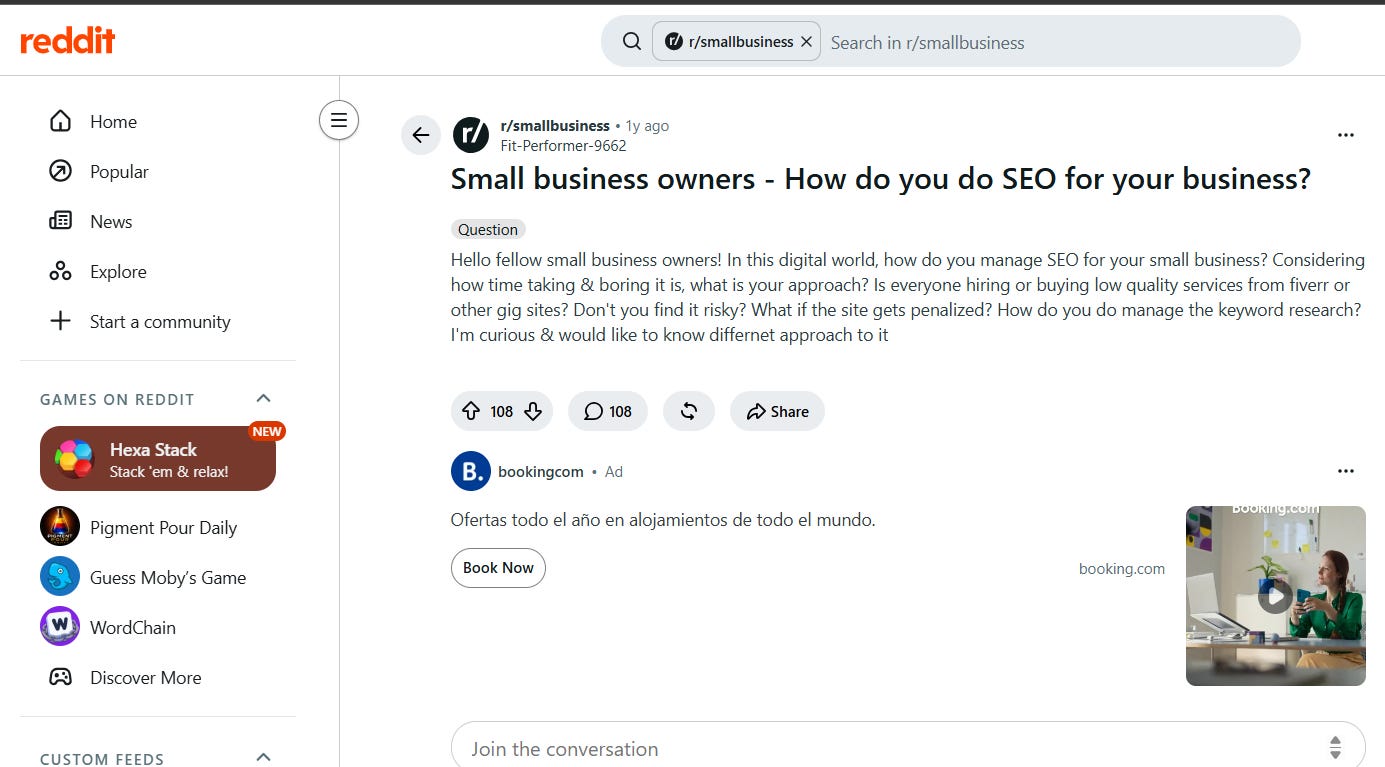
These are often excellent article titles, FAQ sections, and seed keywords.
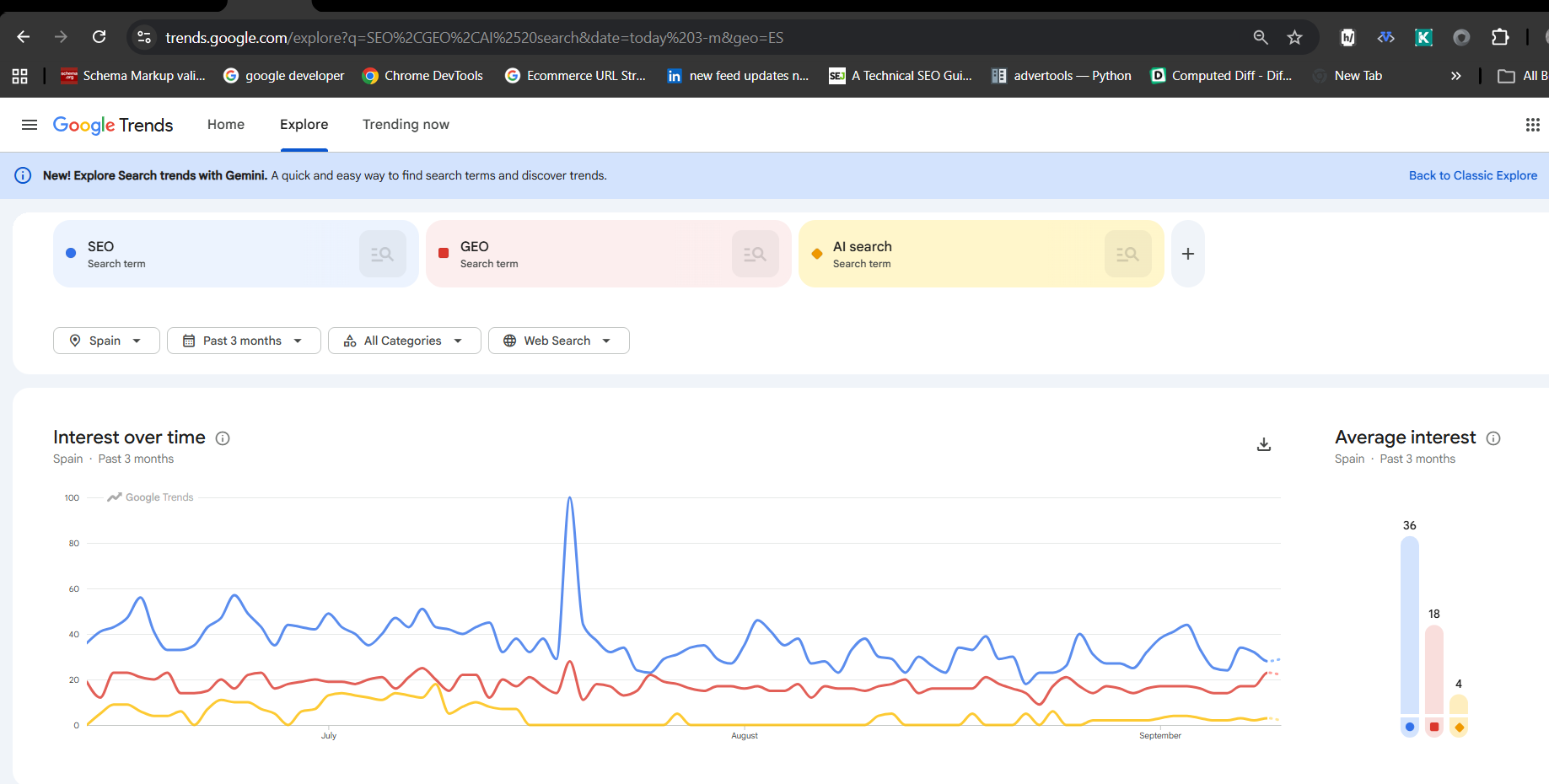
6. Google Trends
Use Google Trends to check whether interest in a topic is stable, growing, seasonal, or declining.
Google Trends is especially useful when:
- You are deciding between two similar phrases.
- Your business is seasonal.
- You target a city, country, or language market.
- You want to compare wording.
Do not use Trends as proof of exact monthly search volume. Use it to understand relative interest and direction.
Step 3: Use one simple keyword tool only if it helps
Tools can save time and offer rough volume or difficulty estimates. But they are estimates, not truth.
For a solo business, you do not need five tools.
Good free or low-cost starting options
Tool
Best use
Free access
Important limitation
Google Search Console
Real queries your site already appears for
Yes
Needs a verified website/property and some search data
Google autocomplete / People Also Ask
Live search language and question ideas
Yes
Does not show reliable volume
Google Trends
Compare relative interest and seasonality
Yes
Not exact monthly volume
Google Keyword Planner
Rough keyword ideas and estimated search ranges
Yes, with Google Ads account
Built for advertisers; data can be broad
AnswerThePublic
Question and comparison ideas
Limited free use
Free searches are limited
AlsoAsked
People Also Ask research
Limited free use
Limits vary
Keyword Surfer / similar browser extension
Quick estimates while browsing results
Often free
Treat volume and difficulty as directional
Ubersuggest
Keyword ideas and simple site research
Limited free use
Free searches are limited
Ahrefs Free Keyword Generator
Quick keyword ideas
Yes, limited
Not a full research workflow
Semrush free account
Basic keyword and domain checks
Limited free use
Strong limits on daily searches
Your tool rule
Start with Google, Search Console, and customer language.
Add one tool only when you need a rough reality check.
Do not pay for a tool because it makes keyword research feel productive. Pay only when it saves time, improves decisions, or supports work that leads to revenue.
Step 4: Decide whether the keyword is realistic
A keyword is not a good first target just because it is relevant.
You need to ask:
“Can a small site like mine realistically create a better or more useful result than what already ranks?”
Read the SERP before trusting a difficulty score
Search the keyword and review page one.
A phrase may be more realistic if you see:
- Smaller businesses.
- Independent experts.
- Forum discussions.
- Reddit or Quora pages.
- Outdated articles.
- Thin articles that do not fully answer the question.
- Pages with weak titles or unclear structure.
- Results that do not serve your specific audience, location, or use case.
A phrase may be harder if you see:
- Huge global brands.
- Government or major educational sites for a sensitive topic.
- Wikipedia.
- Large marketplaces.
- Major publishers.
- Pages that are detailed, current, deeply linked, and clearly better than what you can create now.
Important: competition is not only about site size
Even if big brands appear, you may still have an opportunity when you are more specific.
For example:
Broad, difficult phrase
More realistic variation
SEO tools
SEO tools for solo consultants
Content strategy
Content strategy for a Substack writer
Landing page design
B2B SaaS landing page design for early-stage startups
Strength training
Strength training for busy women over 40
Local SEO
Local SEO for therapists in Barcelona
The goal is not to find “easy keywords.” The goal is to find a specific problem where you can create the most useful result for a defined person.
Step 5: Score your keyword opportunities
Use a simple scorecard. You do not need complex formulas.
Score each potential keyword from 1 to 5.
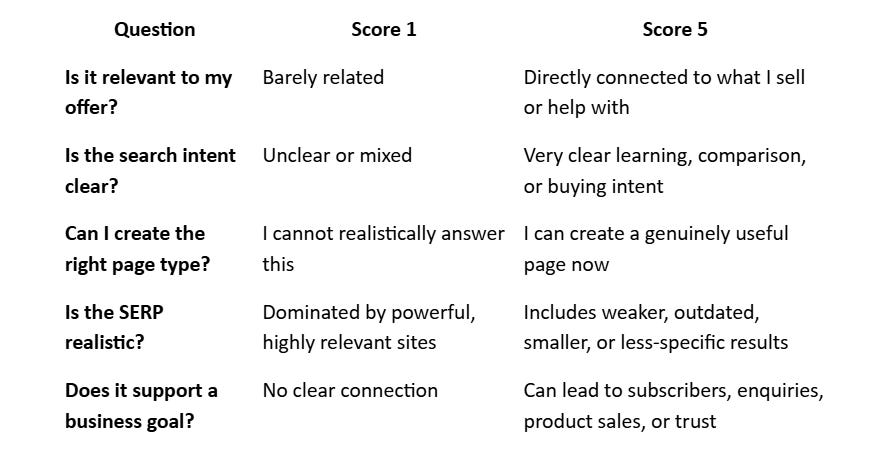
Then choose the highest-scoring opportunities.
Example: keyword scorecard
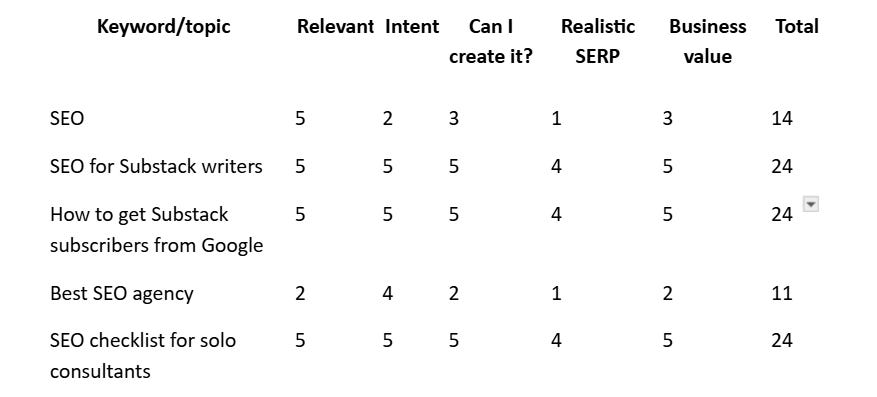
You do not need a perfect 25/25 keyword. You need a relevant, realistic opportunity you can serve well.
Step 6: Map keywords to the right page
One keyword cluster should have one clear page purpose.
Do not create three thin pages targeting almost identical phrases.
For example:
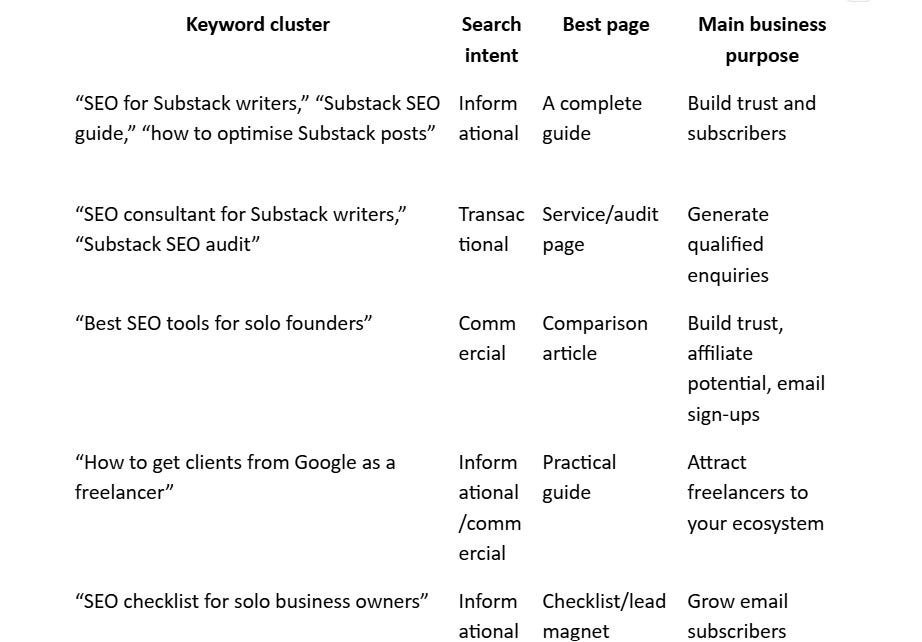
Informational
Checklist/lead magnet
Grow email subscribers
The anti-cannibalisation rule
Do not make multiple pages compete for the same core intent.
Instead of publishing:
- “SEO for freelancers”
- “Freelancer SEO tips”
- “SEO tips for freelance businesses”
- “How freelancers can do SEO”
Create one strong guide that covers the topic fully. Use sections, FAQs, examples, and internal links to related pages.
Then create separate articles only when the intent changes.
For example:
- “SEO for freelancers” → broad guide.
- “How to write a freelancer service page that ranks” → focused implementation guide.
- “SEO consultant for freelancers” → service page.
Step 7: Find your fastest wins in Search Console
If your website already has search impressions, do this first every month.
- Open Google Search Console → Performance → Search results.
- Set a date range of the last three months.
- Click Queries.
- Look for relevant queries where your average position is roughly 8–20.
- Click the query, then review the pages connected to it.
- Choose one page to improve.
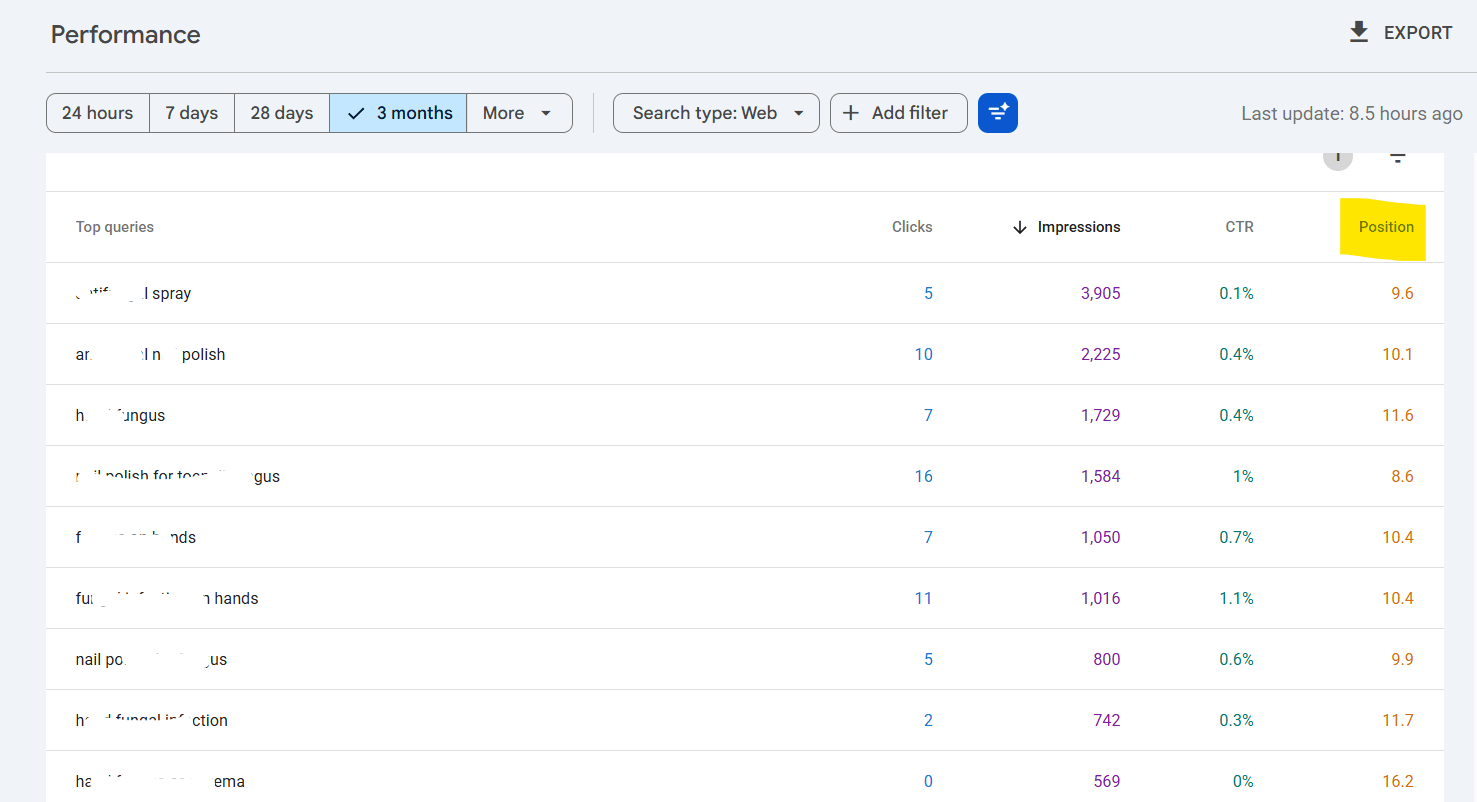
Then improve the page by:
- Making the title better match the query.
- Answering the question earlier.
- Adding a useful section that matches related questions.
- Improving headings.
- Adding examples, proof, or original experience.
- Adding internal links from related posts.
- Adding a relevant CTA.
This is often the highest-return keyword work for a small site because Google already sees a connection between your page and that search.
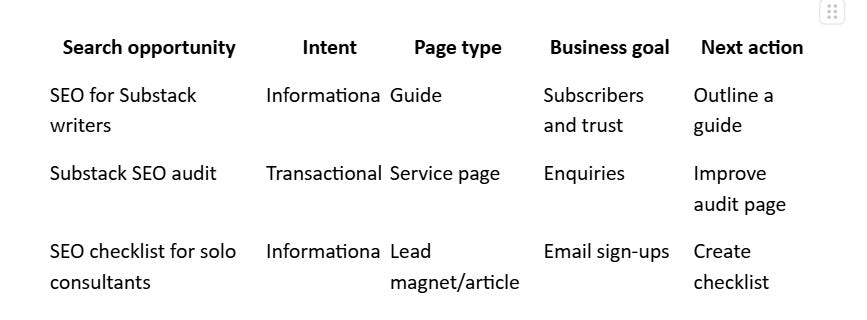
Your 40-minute keyword-research practice
Use this exercise for one service, product, or content area.
First 10 minutes: choose one business goal
Complete this sentence:
I want people to find me when they need help with [problem], because this could lead to [subscriber / enquiry / sale / booking / download].
Example:
I want people to find me when they need help making their Substack content discoverable, because this could lead to email subscribers, an ebook purchase, or a visibility audit.
Next 10 minutes: create your seed list
Write down:
- Three services, products, or expert topics.
- Three problems your audience has.
- Three questions people ask you.
- Three modifiers: audience, location, outcome, or format.
Aim for 10–15 seed ideas.
Next 10 minutes: expand with free sources
For your top three seed topics:
- Check Google autocomplete.
- Open the results page.
- Record “People also ask” questions.
- Record related searches.
- Look in Search Console if you already have data.
Aim for 10–20 possible phrases or questions.
Final 10 minutes: choose three opportunities
For each candidate phrase:
- Identify the intent.
- Search it and check page one.
- Choose the right page type.
- Score it using the simple 1–5 scorecard.
- Select your top three opportunities.
Record them like this:
Completion goal
You are finished with this lesson when you have:
- One clear audience problem.
- A seed list of 10–15 topics or phrases.
- At least 10 search questions or keyword ideas from free sources.
- Three keyword opportunities scored for relevance, intent, realism, and business value.
- One page or article you will create or improve next.
What to ignore for now
Do not spend your first hour:
- Chasing the biggest search-volume keywords.
- Buying several SEO tools.
- Copying competitors’ keyword lists.
- Writing one page for every keyword variation.
- Using a keyword repeatedly until the page sounds unnatural.
- Trusting a difficulty score more than the actual search results.
- Creating content with no link to a business goal.
- Treating AI-generated keyword lists as customer research without checking the live SERP and real audience language.
Final reminder
The best keyword is not the one with the biggest number beside it.
It is the phrase where:
A strong keyword opportunity = real problem + clear intent + realistic chance to rank + useful next step
Example:
Real problem:
A solo business owner is publishing content but getting no traffic.
Clear intent:
They search: “why is my website not getting traffic”
Realistic opportunity:
The phrase is specific enough to compete for, instead of targeting something huge like “SEO.”
Useful next step:
Create a practical diagnostic guide that explains the main causes and then points readers to an SEO checklist or audit.
So instead of chasing:
SEO
you target:
Why is my website not getting traffic?
because it connects a real problem to a clear search and a useful business outcome.
That is how a solo business turns keyword research into discoverability, trust, and income.