You have a SaaS product. It works. People have tried it, some have said nice things about it, and a few are even using it regularly.
But the pipeline is not there.
Not in the way that produces real, predictable revenue. Not in the way where you wake up on Monday and know that a certain number of qualified buyers are going to enter your world this week.
That is the gap this article is about. Not how to get more traffic — how to get leads. Real ones. People with the problem, the budget, and the intent to solve it.
Here is what actually works for early-stage SaaS founders who are not ready to hand a paid ads agency a blank cheque.
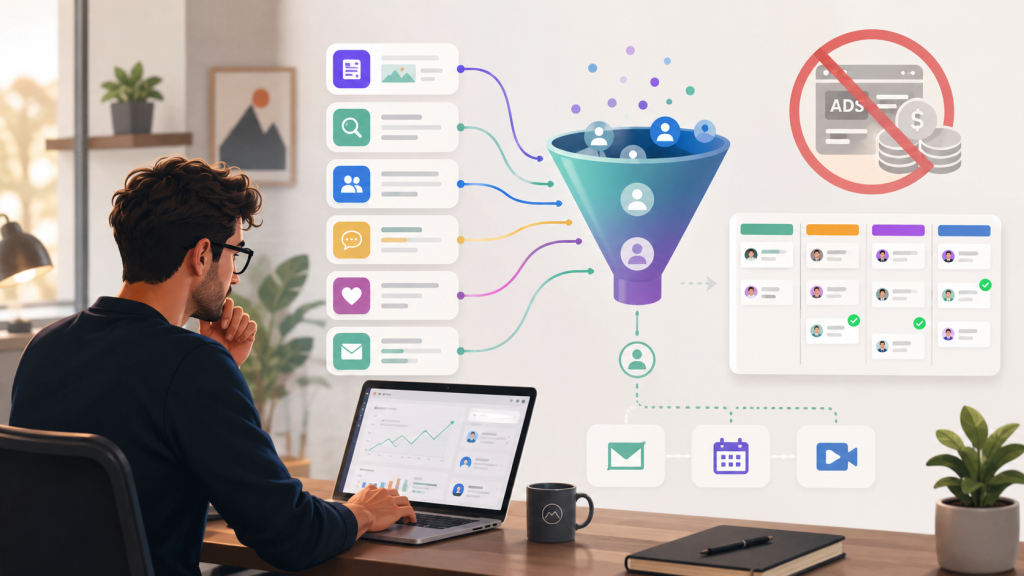
First: Understand Why Traffic Is Not the Same as Leads
This is the mistake that wastes more founder time than almost anything else.
You optimise for visitors. You publish content. You run a few LinkedIn posts. Traffic ticks up. You feel like something is happening.
Then you check the pipeline and nothing has changed.
The reason is simple: visibility and demand are not the same thing.
Someone reading your blog post is not a lead. Someone who signed up for a free tier because the price is zero is not necessarily a lead. Someone who follows your LinkedIn page is not a lead.
A lead is someone who has the specific problem your product solves, knows they want to fix it, and is actively looking for a solution — and who has now entered your world in a trackable way.
Getting to that requires a different approach than just getting seen. It requires building the right system, on the right channels, for the right buyer.
Why Most SaaS Products Fail Without Leads
Step 1: Get Ruthlessly Specific About Who You Are Trying to Reach
Before any channel, any tactic, any piece of content — you need a precise definition of your ideal customer.
“Small businesses” is not a buyer profile. “Founders” is not a buyer profile.
A buyer profile looks like this: ops managers at B2B SaaS companies with 10 to 50 employees who are manually tracking client onboarding in spreadsheets and losing deals because of slow handoffs.
When you know that specifically who you are targeting, everything else becomes easier:
- You know which keywords they search for
- You know what pain language to use on your landing page
- You know which LinkedIn communities they hang out in
- You know what problems to write about
- You know what to say in an outreach message
Without this level of specificity, your lead generation will always feel like shouting into the void. You are producing content and hoping the right person finds it. That is not a system. That is luck.
The practical exercise: Write one sentence that describes your best current customer — their job title, their company type, their size, and the specific problem they had before they started using your product. That sentence is the foundation of everything that follows.
Step 2: Pick the Channels That Match How Your Buyer Actually Buys
One of the most common mistakes in SaaS lead generation is choosing channels based on where you are comfortable posting, rather than where your buyer actually goes when they have the problem.
Here is a practical framework:
If your buyer Googles the problem → SEO and content are essential.
Most B2B SaaS buyers do a significant amount of research before they ever consider a purchase. They search for the problem, read comparisons, look at alternatives, and form opinions before you even know they exist. If you are not showing up in those searches, you are invisible during the most important part of their buying journey.
If your buyer is a business professional → LinkedIn is worth the investment.
Decision-makers at companies — operations leads, team managers, founders, department heads — are on LinkedIn and in a professional mindset when they are there. Founder-led content about the specific problem your product solves builds credibility faster than almost any other channel at the early stage.
If your buyer needs to see the product work → YouTube earns trust at scale.
A well-produced product walkthrough, a tutorial that solves a problem adjacent to what your product addresses, or a breakdown of how to fix the exact pain your product eliminates — these build trust with buyers who are doing research. A YouTube video from twelve months ago still books demos.
If your buyer reads industry newsletters or communities → go there directly.
Before you create your own audience, find where your buyer’s audience already exists. The subreddit, the Slack community, the LinkedIn group, the industry newsletter. Being genuinely useful in those spaces puts you in front of qualified people without building a platform from scratch.
The point is not to be everywhere. It is to be in the 2 to 3 places where your specific buyer spends time and makes decisions.
Why Most SaaS Products Fail Without Leads
Step 3: Create Content That Attracts Buyers, Not Just Readers
Content marketing is one of the highest-leverage lead generation activities for early-stage SaaS — but only if you are creating the right kind of content.
Most SaaS content tries to attract readers. It chases traffic. It targets broad keywords with high volume and low buyer intent.
The content that generates leads targets the problems your buyer is actively trying to solve right now.
Buyer-intent content examples:
- “How to automate [specific workflow] without custom code”
- “[Your category] vs [alternative approach]: which is right for your team”
- “Why [common workaround your buyers use] breaks down at scale — and what to do instead”
- “[Competitor] alternative: what to look for”
- “How [specific role] can reduce [specific pain] by [specific outcome]”
Notice the difference. These are not broad industry posts. They are written for someone who already has the problem and is looking for a way to solve it. That buyer is already motivated. Your content meets them where they are.
The frequency rule: One well-researched, genuinely useful piece targeting a real buyer problem is worth ten generic posts about industry trends. Prioritise depth and specificity over volume.
Step 4: Use SEO to Capture Demand That Already Exists
Search engine optimisation is not about tricking Google. It is about showing up when your buyer types their problem into the search bar.
For SaaS, the highest-value SEO targets are:
Problem-aware searches. Your buyer knows they have a problem and is researching it. “How to manage client onboarding without spreadsheets.” “Best way to automate [workflow].” These searchers are already motivated — they just have not found the solution yet.
Comparison searches. Your buyer is evaluating options. “[Tool A] vs [Tool B].” “[Category] alternatives.” “Best [tool type] for [specific use case].” These are late-stage buyers who are close to a decision. Showing up here with an honest, useful comparison converts well.
Pain-point searches. Your buyer is frustrated with their current situation. “Why does [current tool] not support [feature].” “How to fix [specific problem] in [workflow].” Showing up in these searches positions you as the solution to a problem they are actively trying to escape.
You do not need to rank for everything. Identify 5 to 10 search terms that your ideal buyer would actually type, and build genuinely useful content around each one. That is a more productive SEO strategy than trying to compete for high-volume generic keywords.
Why Most SaaS Products Fail Without Leads
Step 5: Build a Lead Magnet That Works Harder Than Your Homepage
Your homepage tells people what your product does. A lead magnet proves that you understand their problem — and earns their contact information in exchange for something genuinely useful.
The best SaaS lead magnets are not generic. They are specific to the exact problem your ideal buyer is dealing with.
Weak lead magnet: “The Complete Guide to SaaS Growth”
Strong lead magnet: “The 5-Step Onboarding Audit: How to Find Where Clients Are Dropping Off Before They Ever Pay You”
The strong version is specific, it addresses a real pain that a real buyer has, and it signals that the person who created it actually understands the problem. That builds the kind of trust that moves someone from a reader to a lead.
What your lead magnet should do:
- Solve one specific, concrete problem for your ideal buyer
- Be immediately actionable — they should be able to use it today
- Demonstrate your depth of understanding, not just your product’s features
- Feel valuable enough that they are genuinely glad they gave you their email address
Once you have a lead magnet that converts, you have a repeatable way to turn content readers, LinkedIn visitors, and SEO traffic into actual leads in your database.
Step 6: Don’t Let Leads Go Cold — Build a Nurture Sequence
Most SaaS leads are not ready to buy the day they find you.
B2B buying cycles are long. Budget decisions take time. Internal approvals happen slowly. The person who signs up for your lead magnet today might be the right buyer — but three months from now when their quarterly budget review happens.
If you do not have a nurture sequence, those leads disappear. They find you, engage once, and then forget you exist by the time they are ready to make a decision.
A basic nurture sequence for SaaS looks like this:
Email 1 (Day 0): Deliver the lead magnet. Welcome them. Set expectations for what you will share next.
Email 2 (Day 2–3): Go deeper on the problem. Share a specific insight about why the problem they are dealing with is harder to fix than most people realise. No pitch.
Email 3 (Day 5–7): Share a relevant piece of evidence — a case study, a customer result, a specific before-and-after. Start connecting the problem to your product.
Email 4 (Day 9–12): Address the most common objection or hesitation your buyers have. Be honest about it.
Email 5 (Day 14): Clear CTA. Ask them to book a demo, start a trial, or take the next logical step.
After that sequence, move them to a regular newsletter or content email. Stay in contact. The lead who did not convert in week one might convert in month three — but only if you are still in their inbox.
Step 7: Use LinkedIn for Founder-Led Lead Generation
For B2B SaaS, LinkedIn remains one of the most efficient lead generation channels available to early-stage founders — especially if you are not yet ready to invest in paid acquisition.
The reason is simple: the people who make buying decisions at companies are on LinkedIn and are in a professional, problem-solving mindset when they are there.
Founder-led content works particularly well at the early stage because authenticity is still an advantage. A real person talking honestly about a real problem in their industry generates more trust than a polished brand post.
What to post:
- Honest breakdowns of the specific problem your product solves — written for the person who has that problem today
- Behind-the-scenes posts about what you are learning while building
- Case studies from customers (with permission) that show a real before and after
- Contrarian takes on conventional wisdom in your industry
- Questions that invite your ideal buyer to engage and identify themselves
What not to do:
Do not post about your product features. Do not announce updates nobody asked for. Do not write for other founders when your buyer is a department manager.
Write for your buyer. Every post should be something your ideal customer would find useful, interesting, or validating. That is what builds the credibility that eventually converts followers into leads.
Step 8: Make the Demo Request Easy and Obvious
You would be surprised how many SaaS products make it hard to book a demo.
Buried CTAs. Unclear next steps. Contact forms that feel like submitting a tax return. Pricing pages with no clear way to talk to a human.
If your product requires a sales conversation — and most B2B SaaS products benefit from one — the path to booking that conversation should be frictionless.
Practical checklist:
- Is there a “Book a Demo” or “Talk to Us” button visible on every page, including the pricing page?
- Does clicking it lead directly to a calendar booking tool — not a contact form that will be responded to in 48 hours?
- Is the ask small enough? “30-minute intro call” converts better than “schedule a full demo”
- Do you follow up within the same business day if someone submits a form?
Reducing friction at the demo request stage is one of the fastest ways to increase the number of qualified leads you actually speak to — without changing anything about your traffic or content.
Step 9: Do Direct Outreach the Right Way
Cold outreach has a poor reputation because most of it is done badly.
Generic messages sent to irrelevant people at scale are not lead generation. They are spam. They damage your reputation and produce almost no results.
But targeted, personal, problem-led outreach to people who genuinely match your ideal customer profile — done thoughtfully — still works. Especially at the early stage when you need your first 10 to 50 customers.
What good outreach looks like:
- You identify 20 to 30 people who match your ICP precisely
- Your message leads with their specific situation, not your product
- You reference something specific — a post they wrote, a company milestone, a problem you know their role deals with
- You ask for a conversation about the problem, not a demo of your product
- You follow up once or twice, respectfully, then move on
The goal of outreach is to start a conversation with someone who has the problem. Not to close a sale in the first message.
Done right, this approach produces qualified conversations with the exact people you want to speak to. Done at scale with generic copy, it produces spam complaints.
Step 10: Track What Is Actually Working
The final step — and the one most founders skip — is measuring which sources are producing real leads, not just traffic.
You should be able to answer:
- Which content piece brought in the most demo requests this month?
- Which LinkedIn post generated the most inbound messages from qualified people?
- Which keywords are driving the visitors who actually convert?
- Which lead magnet is producing the most engaged email subscribers?
Without this information, you are guessing. And guessing means you keep spending time on channels that are producing traffic but not leads, while underinvesting in the ones that are actually working.
Set up basic UTM tracking on your links. Connect your forms to a simple CRM. Look at the data once a week. Double down on what produces actual leads. Cut what does not.
The Honest Truth About Getting Leads for SaaS
There is no single tactic that fills your pipeline.
What works is building a connected system: a specific buyer profile, content that speaks to their exact problem, SEO that captures their searches, a lead magnet that earns their contact details, a nurture sequence that keeps you present, and a clear path to a conversation.
Each part feeds the next. And over time, it compounds into something that generates qualified leads consistently — without depending on a paid ads budget you may not have yet.
The founders who figure this out early build products that survive. The ones who keep waiting for traffic to magically convert keep watching promising traction go nowhere.
Want the Complete System, Step by Step?
If you are an early-stage or AI SaaS founder dealing with exactly this — getting traffic but not demos, getting signups but not sales, getting attention but not qualified leads — I put the complete framework into a practical, no-fluff guide.
Why Most SaaS Products Fail Without Leads: The Complete System for Predictable Growth goes deeper on every step in this article, with concrete frameworks built specifically for early-stage SaaS founders who want a real pipeline — not just better vanity metrics.
No hype. No vague growth advice. No “just run ads and hope.”
Written by a certified marketer with 15 years of experience helping early-stage SaaS founders and newly launched businesses build lead generation systems that actually compound