A lot of SaaS founders think their problem is growth.
Sometimes it is.
But more often, the real problem starts earlier:
no quality leads.
Not no traffic.
Not no clicks.
Not no signups.
No real pipeline.
No steady flow of people who actually need the product, understand the value, and are close enough to a buying decision to matter.
That is where many SaaS products quietly die.
Not because the product is terrible.
Not because the founders are lazy.
Not because the market is impossible.
Because the product exists… but the demand system does not.
And without that system, even a good product starts to feel broken.
The pattern is always the same
The story usually sounds like this:
“We built something solid.”
“Early users liked it.”
“The tech works.”
“But now… nothing.”
No demos.
No reliable sales conversations.
No clear path from attention to revenue.
Maybe the site is getting some visits.
Maybe a few people are signing up.
Maybe a post performs well once in a while.
But revenue stays flat.
That is the moment when founders start to panic.
Because now the problem feels confusing.
On paper, things are happening.
In reality, the business is stuck.
Traffic is not the same as demand
This is one of the most common traps in SaaS.
Founders see:
- site traffic
- free users
- waitlist signups
- content impressions
- maybe even decent engagement
And assume the machine is working.
But none of that guarantees sales.
A SaaS can get attention and still have no real demand system.
That happens when you attract people who are:
- curious, but not urgent
- interested, but not qualified
- problem-aware, but not ready to act
- free-user friendly, but not buyer-friendly
That is why “we’re getting traffic, but no demos” is such a common founder complaint.
The issue is usually not that nobody is showing up.
It is that the wrong people are showing up, or the right people are not being moved toward the next step clearly enough.
Great products still fail when leads stay random
A lot of technical founders secretly believe:
“If the product is good enough, people will come.”
Sometimes they do.
Usually not enough.
Because product quality alone does not create a lead system.
A lead system is what turns:
- visibility into interest
- interest into trust
- trust into conversations
- conversations into pipeline
Without that, growth feels random.
One week you feel hopeful.
The next week it feels dead again.
That kind of business is exhausting.
Not because there is zero potential.
Because there is no predictable path from “someone found us” to “someone wants to buy.”
What “no quality leads” actually means
It usually looks like one of these:
- people visit, but do not book a demo
- free trials start, but usage stays shallow
- signups come in, but nobody is the right fit
- traffic grows, but pipeline does not
- founders rely on luck, referrals, or one-off posts
- every good week feels accidental
This is the dangerous middle.
The product is not invisible.
But it is not converting into real business momentum either.
That is where many promising SaaS products stall for months.
The real issue is usually not “more marketing”
It is usually one of these:
1. Wrong audience
You are attracting people who are not painful-enough problem holders.
They like the idea.
They do not need the solution badly enough.
2. Weak positioning
The product may be useful, but the message is still fuzzy.
People do not clearly understand:
- what it does
- who it is for
- why it matters now
- why it is better than the alternative
3. No lead path
There is no clear system moving people from discovery to conversation.
Just scattered activity.
4. Too much focus on traffic
More traffic feels productive.
But if the traffic is low-intent, it becomes a vanity metric.
5. No repeatable acquisition engine
Everything depends on bursts:
- founder posting
- random referrals
- one good launch
- one lucky mention
That is not a system.
What a real lead system actually does
A real lead system is not “more content” or “run ads.”
It is a structure that consistently answers:
- Where do the right buyers come from?
- Why do they notice us?
- What makes them trust us?
- What moves them toward a demo or sale?
- How do we repeat that without chaos?
That system usually includes some mix of:
- clear positioning
- problem-aware content
- offer/message clarity
- demand capture
- conversion points
- follow-up
- measurement
Simple, but not accidental.
The goal is not just more leads
This matters.
A lot of founders say they want more leads.
What they actually need is:
more qualified leads with stronger intent.
Because bad leads create fake progress.
They fill the funnel and empty your time.
The right lead system does not just increase activity.
It improves the quality of attention entering the business.
What founders should focus on first
If I were building a simple lead system for an early-stage SaaS, I would start here:
1. Clarify the problem you solve
Not broad.
Not impressive-sounding.
Clear.
Bad:
“We help teams streamline operations.”
Better:
“We help agency owners automate client reporting without spreadsheets.”
2. Identify the real buyer
Not “businesses.”
Not “teams.”
Who exactly feels this problem enough to act?
3. Build pages and content around buying-intent problems
Not just thought leadership.
Things like:
- comparison pages
- “how to solve X” pages
- use-case pages
- industry-specific landing pages
- pain-point content
- SEO pages that match real searches
4. Create one clear conversion path
Demo.
Free trial.
Audit.
Call.
Waitlist.
Pick one primary next step and make it obvious.
5. Measure qualified movement, not vanity numbers
Not just:
- clicks
- impressions
- views
- traffic
Also:
- qualified demos
- intent signals
- pipeline quality
- sales conversations
- conversion by source
Why this matters more in AI SaaS
AI SaaS is even more vulnerable to this problem because attention is high, but clarity is often low.
A lot of AI products get curiosity clicks.
But curiosity is weak if it does not turn into:
- understanding
- trust
- urgency
- action
That is why AI SaaS founders need even more lead clarity, not less.
The market is noisy.
You do not win by being louder.
You win by being easier to understand and easier to trust.
The uncomfortable truth
A lot of SaaS products do not die because nobody wanted them.
They die because the founders never built a repeatable way for the right buyers to discover, understand, and act.
That is a very fixable problem.
But only when you stop treating lead generation like an afterthought.
Because without leads, even a strong product starts looking weak.
And with the right lead system, even a small product can start building real momentum.
Final thought
If your SaaS is getting traffic but no demos, signups but no revenue, or attention but no pipeline, the answer is probably not “work harder.”
It is probably:
- get clearer
- get more specific
- get closer to buyer intent
- and build a lead system that actually makes sense
Because most SaaS products do not need more random activity.
They need a better path from visibility to demand.
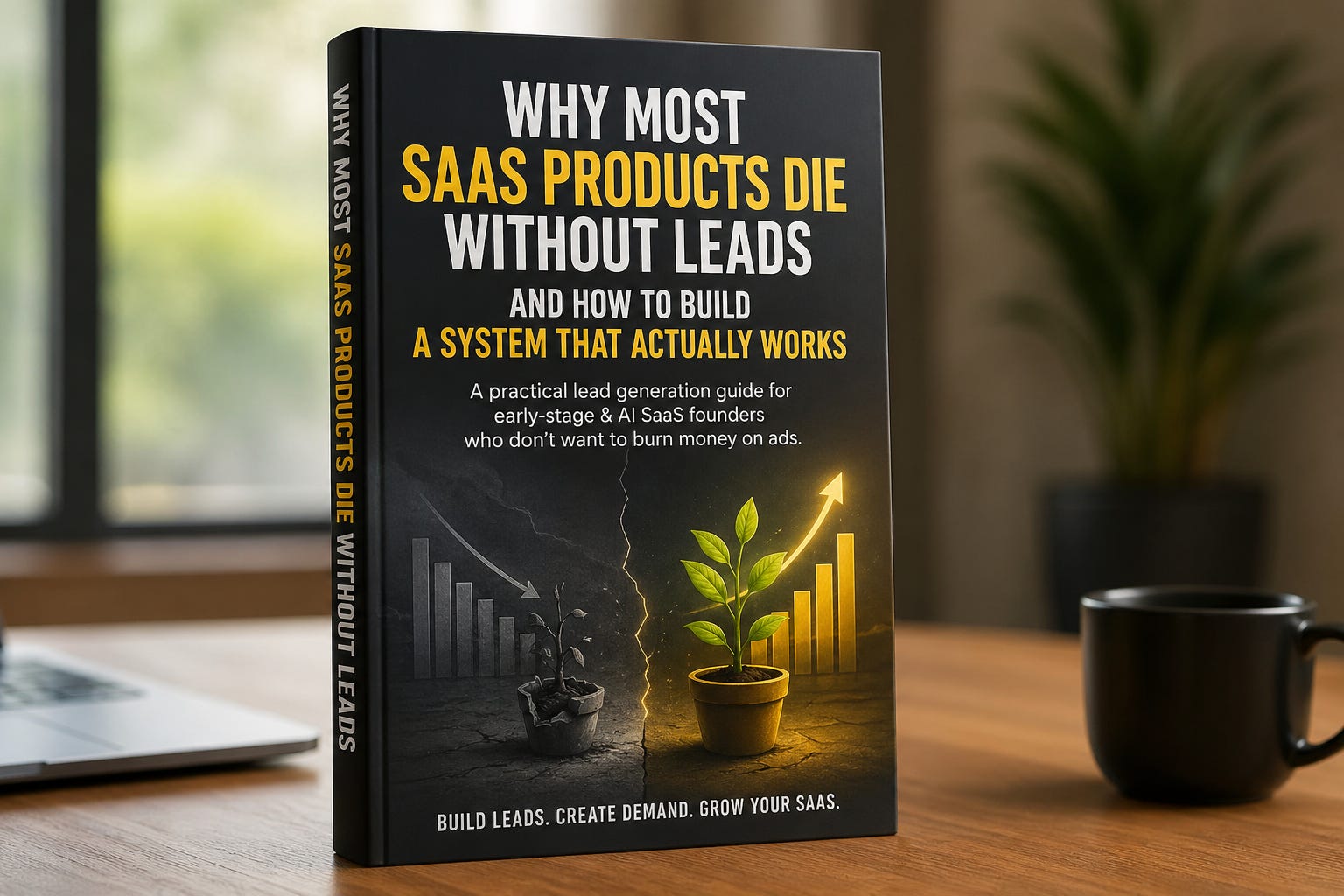
I put together a practical guide for early-stage and AI SaaS founders who want to build a lead generation system without burning money on ads.